GraphRAG 與向量 RAG:優缺點與混合式 RAG 應用場景
文章資訊
作者:QuarkAndCode 日期:2026-06-13
原文標題:GraphRAG vs Vector RAG: Pros, Cons & Hybrid RAG Use Cases
Medium 原連結:https://medium.com/@QuarkAndCode/graphrag-vs-vector-rag-pros-cons-hybrid-rag-use-cases-c6e92b3615d5
📝 重點摘要
TL;DR
向量 RAG 擅長語意廣度檢索,GraphRAG 擅長關係深度推理,實務最佳解常是兩者混合。
核心問題
LLM 在回答「誰核准了部署、他向誰匯報」這類需追溯關係鏈的問題時容易失準。文章比較向量 RAG(依語意相似度)與 GraphRAG(依實體間明確關係)兩種檢索範式,說明各自適用情境與如何混合。
關鍵發現 / 數據
- data.world 2023 保險領域 SQL schema 基準(43 題):GPT-4 直接對 SQL 查詢平均執行準確率僅 16.7%。
- 改用知識圖譜(SPARQL)表示後,準確率躍升至 54.2%,約 3 倍提升。
- 在「高 schema 複雜度」象限,無 KG 準確率掉到 0%,而 KG 方法仍維持非零準確率。
- FalkorDB 宣稱其 GraphRAG SDK 內部測試達「90%+」——屬廠商自報數據,非獨立驗證,應保留懷疑。
- 結論:當結構與關係是問題核心時,注入明確語意可大幅改善有依據的回答。
方法亮點
- 混合架構雙記憶:同時建立向量索引(廣度召回)與知識圖譜(結構推理),由 retrieval router 依問題類型分流。
- 實體解析(entity resolution):去重「Bill G.」與「William Gates」避免圖譜碎片化。
- 社群偵測 + 摘要:將圖譜分群並生成 community summary,回答跨文件的宏觀問題。
- 混合連接技巧:對向量結果做 entity linking、用 intent classifier 路由、以圖譜 proximity/centrality 重排序、結合 graph embeddings 與 text embeddings。
對我的研究有用嗎?
作為入門掃盲與架構決策清單頗實用,尤其「vectors for breadth, graphs for depth」的路由思路、以及混合連接的五項具體技巧(entity linking、intent 分類、node ID 標籤、graph 重排序、graph embedding)值得借鏡。data.world 的 SQL vs KG 基準可作為「結構化語意提升 grounding」的引用,但須注意它測的是 SQL/SPARQL 而非 PDF chunking,外推到 GraphRAG 需謹慎。
評語
科普向綜述,整合多家廠商部落格,觀念清楚但無原創實驗;數據多為二手引用且夾雜廠商自報,深度有限——適合快速建立全貌,不值得逐字深讀。
🌐 中英對照
Author: QuarkAndCode 作者:QuarkAndCode
Published: 發布日期:
Source: https://medium.com/@QuarkAndCode/graphrag-vs-vector-rag-pros-cons-hybrid-rag-use-cases-c6e92b3615d5 來源:https://medium.com/@QuarkAndCode/graphrag-vs-vector-rag-pros-cons-hybrid-rag-use-cases-c6e92b3615d5
Fetched: 2026-06-13T00:05:35.250952 擷取時間:2026-06-13T00:05:35.250952
GraphRAG vs Vector RAG: Pros, Cons & Hybrid RAG Use Cases / GraphRAG 與向量 RAG 之比較:優點、缺點與混合式 RAG 的應用情境
Press enter or click to view image in full size
按 Enter 或點擊以檢視完整尺寸的圖片
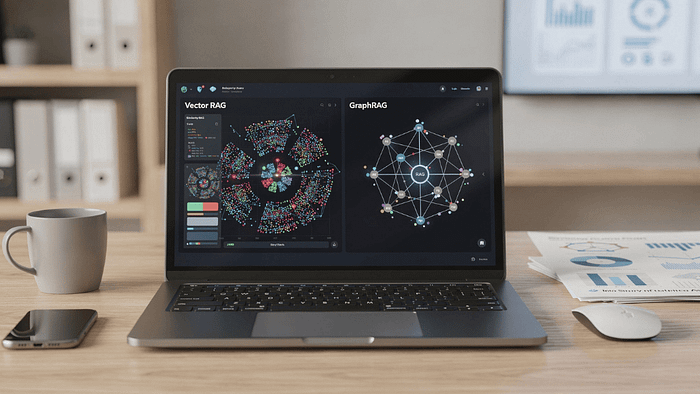
Large language models can sound confident even when they’re missing key facts — especially facts that live in your company’s documents, databases, or constantly changing internal knowledge. Retrieval-Augmented Generation (RAG) is the practical fix: before an AI answers, it retrieves relevant information from an external source (like a document store or database) and adds that context to the prompt so the model can respond with more grounded, up-to-date answers.
大型語言模型 (Large Language Model) 即使缺少關鍵事實,也可能聽起來很有自信——尤其是那些存在於公司文件、資料庫,或不斷變動的內部知識中的事實。檢索增強生成 (Retrieval-Augmented Generation, RAG) 是實務上的解決方案:在 AI 回答之前,它會先從外部來源(如文件庫或資料庫)檢索相關資訊,並將該脈絡加入提示 (prompt) 中,讓模型能給出更有依據、更即時的答案。
But “RAG” isn’t just one technique. The two most common approaches today are:
但「RAG」並不只是單一技術。如今最常見的兩種做法是:
- Vector RAG, which finds information by semantic similarity (things that “mean” something similar).
-
向量 RAG (Vector RAG),它透過語意相似度 (semantic similarity) 來尋找資訊(也就是「意義」相近的事物)。
-
GraphRAG, which finds information by explicit relationships between entities (things that are connected in a meaningful way).
- GraphRAG,它透過實體之間的明確關係 (explicit relationships) 來尋找資訊(也就是以有意義的方式相互連結的事物)。
If you’ve ever wondered why an AI chatbot can flawlessly summarize a policy PDF yet struggle with a question like “Who approved the deployment, and who do they report to?”, you’re already feeling the difference between these two “memory” styles.
如果你曾納悶為什麼一個 AI 聊天機器人能完美地摘要一份政策 PDF,卻對「是誰核准了這次部署,而他們又向誰報告?」這類問題感到吃力,那你其實已經體會到這兩種「記憶」風格之間的差異了。
RAG in one sentence
一句話說明 RAG
RAG is a “retrieve first, then generate” workflow: it pulls relevant external context (documents, knowledge base entries, structured data) and uses that context to shape the model’s answer — mainly to reduce hallucinations and missed context.
RAG 是一種「先檢索、再生成」的工作流程:它會擷取相關的外部脈絡(文件、知識庫條目、結構化資料),並利用該脈絡來形塑模型的答案——主要目的是減少幻覺 (hallucination) 與遺漏的脈絡。
The important detail is how you retrieve. That’s where vectors and graphs diverge.
關鍵細節在於你如何檢索。而這正是向量 (vector) 與圖譜 (graph) 分道揚鑣之處。
Vector RAG: the “meaning-based” memory / 向量 RAG:「以意義為基礎」的記憶
What it is / 它是什麼
Vector RAG converts text (and sometimes images/audio) into embeddings — numerical vectors that represent meaning. A user query becomes a vector too, and the system retrieves the “nearest” chunks in vector space using similarity measures (often cosine similarity) and approximate nearest-neighbor search.
向量 RAG 會將文字(有時也包括圖片/音訊)轉換成嵌入向量 (embeddings)——也就是用來代表意義的數值向量。使用者的查詢也會變成一個向量,系統則使用相似度量度(通常是餘弦相似度 (cosine similarity))與近似最近鄰搜尋 (approximate nearest-neighbor search),在向量空間中檢索「最接近」的文字區塊 (chunk)。
How it works / 它如何運作
A typical vector RAG flow looks like this:
一個典型的向量 RAG 流程看起來像這樣:
- Chunk documents into passages that fit your retrieval and model context size.
-
將文件切塊 (chunk),分成符合你檢索與模型脈絡長度需求的段落。
-
Embed each chunk into a vector.
-
將每個區塊嵌入 (embed) 成一個向量。
-
Store vectors in a vector database or index.
-
將向量儲存在向量資料庫或索引中。
-
When a user asks a question, embed the query.
-
當使用者提問時,將查詢嵌入成向量。
-
Retrieve top-k similar chunks.
-
檢索出最相似的前 k 個區塊 (top-k similar chunks)。
-
Feed those chunks into the LLM to generate an answer grounded in retrieved text.
- 將這些區塊餵給 LLM,以生成一個立基於所檢索文字的答案。
Why people like it / 人們為何喜歡它
Vector RAG is popular because it’s:
向量 RAG 之所以受歡迎,是因為它:
- Fast and scalable for huge collections of unstructured text.
-
對於龐大的非結構化文字集合而言,快速且可擴展。
-
Quick to implement (embed → store → search).
-
實作迅速(嵌入 → 儲存 → 搜尋)。
-
Flexible with “messy” data, where relationships aren’t formally defined.
- 對「雜亂」資料具有彈性,適用於關係尚未正式定義的情境。
That’s why vector RAG is often the default for customer support, semantic search, chatbots, and document summarization workflows.
這就是為什麼向量 RAG 經常成為客戶支援、語意搜尋、聊天機器人與文件摘要等工作流程的預設選擇。
Where it tends to break down / 它通常會在哪裡失效
Vector RAG is excellent at “find me something relevant,” but weaker at “prove the relationship chain.” Common limitations include:
向量 RAG 很擅長「幫我找出相關的東西」,但在「證明關係鏈」方面較弱。常見的限制包括:
- Losing relational context when information is split into chunks.
-
當資訊被切成區塊時,會遺失關係脈絡 (relational context)。
-
Multi-step / multi-hop reasoning isn’t native — vectors don’t explicitly encode relationships like manager → employee → approval.
-
不原生支援多步驟/多跳推理 (multi-step / multi-hop reasoning)——向量並不會明確編碼像主管 → 員工 → 核准這樣的關係。
-
Explainability is harder: similarity scores are not an intuitive “reason trail.”
-
可解釋性 (explainability) 較困難:相似度分數並不是一條直觀的「推理軌跡」。
-
Embedding drift over time: as models or data change, embeddings can become stale and need re-embedding.
- 嵌入向量會隨時間漂移 (embedding drift):隨著模型或資料變動,嵌入向量可能會過時,而需要重新嵌入。
Vector RAG can be strengthened with techniques like reranking (e.g., learning-to-rank) to improve what gets surfaced first, but that adds complexity and can increase latency.
向量 RAG 可以透過重新排序 (reranking)(例如排序學習 (learning-to-rank))等技術來強化,以改善最先被呈現出來的內容,但這會增加複雜度,也可能拉高延遲 (latency)。
GraphRAG: the “relationship-based” memory / GraphRAG:「以關係為基礎」的記憶
What it is / 它是什麼
GraphRAG uses a knowledge graph — a network where:
GraphRAG 使用知識圖譜 (Knowledge Graph)——這是一種網路,其中:
- Nodes represent entities (people, products, projects, accounts, concepts)
-
節點 (Nodes) 代表實體(人物、產品、專案、帳戶、概念)
-
Edges represent relationships (works_for, approved, depends_on, interacts_with, located_in, etc.)
- 邊 (Edges) 代表關係(works_for(任職於)、approved(核准)、depends_on(依賴於)、interacts_with(互動於)、located_in(位於)等)
Instead of asking “what text is similar?”, GraphRAG asks “what is connected, and how?”
GraphRAG 問的不是「哪些文字相似?」,而是「什麼東西彼此連結,又是如何連結的?」
A key distinction from vector RAG: GraphRAG doesn’t just embed text chunks — it maps data into a graph database so retrieval can follow links between entities.
與向量 RAG 的一個關鍵差異是:GraphRAG 不只是嵌入文字區塊——它會將資料對應到圖譜資料庫 (graph database) 中,讓檢索能夠沿著實體之間的連結進行。
How it works / 它如何運作
A GraphRAG pipeline often includes:
一個 GraphRAG 管線 (pipeline) 通常包含:
- Model the domain (what entity types and relationship types matter).
-
建模領域 (model the domain)(哪些實體類型與關係類型是重要的)。
-
Extract entities and relationships from structured and unstructured sources (often using NLP/LLMs).
-
從結構化與非結構化來源中抽取實體與關係 (extract entities and relationships)(通常使用自然語言處理 (NLP)/LLM)。
-
Resolve entities (deduplicate “Bill G.” vs “William Gates” so the graph doesn’t fragment).
-
解析實體 (resolve entities)(將「Bill G.」與「William Gates」去重,以免圖譜碎裂)。
-
Store in a graph database.
-
儲存於圖譜資料庫中。
-
At query time, link the question to entities, traverse relevant neighborhoods (k-hop paths), retrieve a supporting subgraph, then feed structured facts (often as triples/statements with provenance) into the LLM.
- 在查詢時,將問題連結到實體,遍歷相關的鄰域(k 跳路徑 (k-hop paths)),檢索出一個支撐性的子圖 (subgraph),再將結構化事實(通常以帶有來源出處 (provenance) 的三元組 (triples)/陳述形式呈現)餵給 LLM。
Why people use it / 人們為何使用它
GraphRAG shines when you need:
當你有以下需求時,GraphRAG 便能大放異彩:
- Multi-hop reasoning across chains of facts, not just one matching paragraph.
-
跨越事實鏈的多跳推理 (multi-hop reasoning),而不只是某一段相符的段落。
-
Explainability: you can show the path (entity → relationship → entity) that led to an answer.
-
可解釋性:你可以展示導向某個答案的路徑(實體 → 關係 → 實體)。
-
Better retention of context and relationships, especially in domains where “how things connect” is the real meaning.
- 更佳地保留脈絡與關係,尤其是在「事物如何連結」才是真正意義所在的領域中。
That’s why GraphRAG is often positioned for biomedicine, compliance/legal, financial analysis, supply chains, and other domains where relational structure is essential.
這就是為什麼 GraphRAG 經常被定位於生物醫學、合規/法律、財務分析、供應鏈,以及其他關係結構至關重要的領域。
The trade-offs
取捨之處
GraphRAG isn’t “free accuracy.” It comes with real costs:
GraphRAG 並不是「免費的準確度」。它伴隨著實實在在的成本:
- Upfront modeling work (schema/ontology design) and ongoing curation.
-
前期的建模工作(綱要 (schema)/本體論 (ontology) 設計)以及持續的維護整理。
-
More specialized skills, including graph modeling and graph query languages (like Cypher or SPARQL).
-
更專門的技能,包括圖譜建模與圖譜查詢語言(如 Cypher 或 SPARQL)。
-
Scaling can be trickier: graph traversals can get expensive as graphs grow dense.
- 擴展可能更為棘手:隨著圖譜變得稠密,圖譜遍歷的成本可能會升高。
In short: GraphRAG is often “higher ceiling, higher setup cost.”
簡而言之:GraphRAG 往往是「上限更高,但建置成本也更高」。
Key differences at a glance / 關鍵差異一覽
Press enter or click to view image in full size
按 Enter 或點擊以檢視完整尺寸的圖片
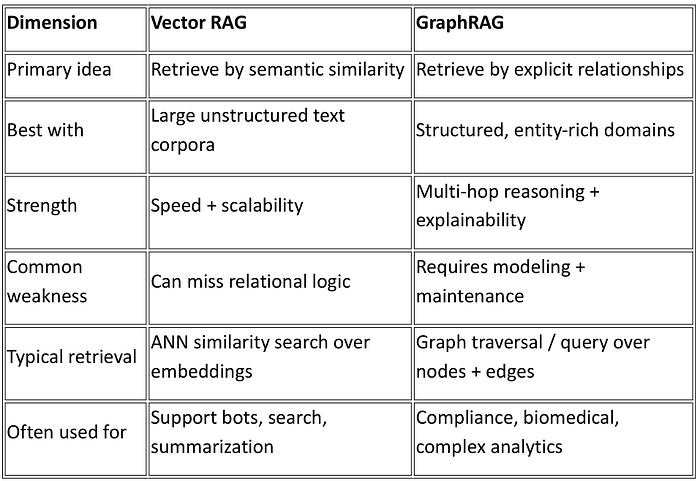
This summary reflects the side-by-side comparisons and trade-offs described across Meilisearch and Instaclustr’s guides.
這份摘要反映了 Meilisearch 與 Instaclustr 各自指南中所描述的並列比較與取捨。
What benchmark-style evidence suggests / 基準測試類型的證據說明了什麼
Most teams first meet RAG through “chunk PDFs + vector search.” That pattern works well for straightforward queries like “What is our remote work policy?”
大多數團隊初次接觸 RAG 都是透過「切塊 PDF + 向量搜尋」。這種模式對於像「我們的遠距工作政策是什麼?」這類直接的查詢運作得相當好。
But when questions become schema-heavy or require business semantics, purely “surface-level” retrieval often struggles. One way to see this is through a 2023 technical report published by data.world that introduced an enterprise benchmark for question-answering on an insurance-domain SQL schema (43 questions). It found:
但當問題變得高度依賴綱要 (schema-heavy),或需要商業語意 (business semantics) 時,純粹「表層」的檢索往往會力不從心。要看出這一點,方法之一是參考 data.world 於 2023 年發布的一份技術報告,該報告針對一個保險領域的 SQL 綱要(共 43 個問題)提出了一套企業級的問答基準測試 (benchmark)。它發現:
- Asking GPT‑4 questions directly against SQL (no knowledge graph) achieved 16.7% average overall execution accuracy.
-
直接針對 SQL 向 GPT‑4 提問(無知識圖譜)所達到的整體平均執行準確度為 16.7%。
-
Asking the same questions over a knowledge graph representation (SPARQL) achieved 54.2% average overall execution accuracy.
-
在知識圖譜表示法(SPARQL)上提出相同的問題,則達到 54.2% 的整體平均執行準確度。
-
In the high schema complexity quadrants, accuracy without the KG dropped to 0%, while the KG approach still produced non-zero accuracy.
- 在高綱要複雜度 (high schema complexity) 的象限中,未使用知識圖譜 (KG) 的準確度降至 0%,而採用 KG 的做法仍能產生非零的準確度。
Even though this benchmark is framed around SQL vs. KG/SPARQL (not “PDF chunking”), it reinforces a practical lesson relevant to GraphRAG: when the structure and relationships are central to the question, injecting explicit semantics can dramatically improve grounded answering.
儘管這項基準測試是圍繞著 SQL 對比 KG/SPARQL(而非「PDF 切塊」)來設計的,它仍強化了一個與 GraphRAG 相關的實務啟示:當結構與關係是問題的核心時,注入明確的語意能大幅改善有依據的回答品質。
FalkorDB’s analysis uses this style of benchmark discussion to argue that graph-based retrieval is particularly important for schema-bound enterprise questions — and reports internal improvements from their GraphRAG SDK beyond the benchmark baseline (noting “90%+” in their internal testing claims). Treat that part as vendor-reported performance rather than an independent result.
FalkorDB 的分析運用這種基準測試式的論述,主張以圖譜為基礎的檢索對於受綱要約束的企業級問題尤其重要——並回報其 GraphRAG SDK 在基準基線之外取得了內部的改善(在其內部測試的宣稱中提到「90% 以上」)。對於這部分,應視為廠商自行回報的效能,而非獨立的結果。
Why “hybrid” keeps coming up / 為什麼「混合式」一再被提及
A theme across multiple sources is that many real systems don’t choose one approach forever — they combine them.
橫跨多個來源的一個共同主題是:許多實際系統並不會永遠只選擇一種做法——它們會將兩者結合起來。
Meilisearch describes a common production pattern: use vector search for broad recall (fast, scalable) and then use graph traversal for structured reasoning when relationships matter.
Meilisearch 描述了一種常見的正式環境 (production) 模式:使用向量搜尋來達成廣泛的召回 (broad recall)(快速、可擴展),然後在關係重要時,使用圖譜遍歷來進行結構化推理。
Optimum Partners puts it in “memory architecture” terms: vectors are great at fuzzy retrieval, but graphs help with deterministic relationship questions — and a hybrid system routes different question types to different retrieval backends.
Optimum Partners 則以「記憶體架構 (memory architecture)」的角度來闡述:向量擅長模糊檢索 (fuzzy retrieval),但圖譜則有助於處理確定性的關係問題 (deterministic relationship questions)——而混合式系統會將不同類型的問題路由 (route) 到不同的檢索後端。
Instaclustr’s “tips from the expert” section gets even more concrete about how to make the hybrid connection work, including:
Instaclustr 的「專家提示」章節對於如何讓這種混合式銜接運作起來,提供了更具體的說明,包括:
- Run entity linking on vector-retrieved documents to map content to graph nodes.
-
對向量檢索出的文件執行實體連結 (entity linking),將內容對應到圖譜節點。
-
Use an intent classifier to decide whether a query needs relational reasoning (graph) or semantic matching (vector).
-
使用意圖分類器 (intent classifier) 來判定某個查詢需要的是關係推理(圖譜)還是語意比對(向量)。
-
Tag vector chunks with graph node IDs for easy cross-navigation.
-
為向量區塊標註上圖譜節點 ID (graph node IDs),以便於交叉導覽。
-
Re-rank vector results using graph proximity/centrality.
-
使用圖譜鄰近度/中心性 (graph proximity/centrality) 來重新排序向量結果。
-
Use graph embeddings alongside text embeddings to blend structural and semantic similarity.
- 在文字嵌入之外搭配使用圖譜嵌入 (graph embeddings),以融合結構相似度與語意相似度。
A practical hybrid blueprint / 一個實用的混合式藍圖
Here’s a general-reader version of the “hybrid GraphRAG” architecture that shows up in multiple guides:
以下是多份指南中都出現過的「混合式 GraphRAG」架構,這裡提供一個適合一般讀者的版本:
1) Ingestion: build both memories / 1) 攝取 (Ingestion):建立兩種記憶
- Store raw text for vector search.
-
儲存原始文字以供向量搜尋使用。
-
Extract entities/relationships to build the graph.
-
抽取實體/關係以建構圖譜。
-
Deduplicate entities so your graph doesn’t fragment into near-duplicates.
- 將實體去重,以免你的圖譜碎裂成許多近乎重複的節點。
2) Organize the graph for “big picture” questions / 2) 為「宏觀」問題整理圖譜
Some approaches cluster related parts of the graph into “communities,” then generate summaries for those communities — so the system can answer higher-level questions that span many documents (“What were the top risks across projects last month?”).
有些做法會將圖譜中相關的部分聚集成「社群 (communities)」,再為這些社群生成摘要——如此一來,系統便能回答橫跨眾多文件的較高層次問題(「上個月各專案中最主要的風險有哪些?」)。
3) Retrieval routing: pick the right tool per question / 3) 檢索路由:為每個問題挑選正確的工具
A “retrieval router” can:
一個「檢索路由器 (retrieval router)」可以:
- Query the graph for “specific facts” and relationship chains (who approved what, who reports to whom).
-
向圖譜查詢「特定事實」與關係鏈(誰核准了什麼、誰向誰報告)。
-
Query the vector index for “general context” and broad thematic retrieval.
-
向向量索引查詢「一般脈絡」與廣泛的主題式檢索。
-
Let the LLM synthesize the two into one answer that’s both context-rich and relationship-grounded.
- 讓 LLM 將兩者綜合成一個既脈絡豐富、又立基於關係的單一答案。
This is the core idea behind “vectors for breadth, graphs for depth.”
這就是「以向量求廣度、以圖譜求深度」背後的核心理念。
How to choose: a decision checklist / 如何選擇:一份決策檢查清單
If you’re designing a system for general readers (or an internal business audience), ask these questions:
如果你正在為一般讀者(或內部商業受眾)設計一套系統,請問問自己這些問題:
Choose Vector RAG when… / 在以下情況選擇向量 RAG⋯⋯
- Your data is mostly unstructured text (docs, tickets, wikis).
-
你的資料大多是非結構化文字(文件、工單、維基)。
-
Your questions are mostly “find relevant passages” rather than “trace a relationship chain.”
-
你的問題大多是「找出相關段落」,而非「追蹤一條關係鏈」。
-
You need speed and easy scaling across large corpora.
-
你需要在大型語料庫上具備速度與輕鬆的擴展能力。
-
You want to ship quickly and iterate.
- 你想要快速推出產品並反覆迭代。
Choose GraphRAG when… / 在以下情況選擇 GraphRAG⋯⋯
- Your domain depends on entities and relationships (compliance, biomedical interactions, supply chain dependencies).
-
你的領域仰賴實體與關係(合規、生物醫學交互作用、供應鏈依賴關係)。
-
You must answer multi-hop or constraint-heavy questions reliably.
-
你必須可靠地回答多跳或高度受限制的問題。
-
You need explainability (you want to show how the answer was derived).
-
你需要可解釋性(你想展示答案是如何推導出來的)。
-
You can invest in modeling and maintenance.
- 你有能力投入建模與維護。
Choose Hybrid when… / 在以下情況選擇混合式⋯⋯
- You have mixed data (documents + structured systems).
-
你擁有混合資料(文件 + 結構化系統)。
-
You want both “semantic recall” and “relationship correctness.”
-
你同時想要「語意召回」與「關係正確性」。
-
You’re dealing with enterprise “analyst-like” questions where causality and connections matter.
- 你正在處理企業中「類似分析師」的問題,其中因果關係與連結至關重要。
Common “gotchas” / 常見的「陷阱」
Gotcha 1: Chunking breaks meaning / 陷阱 1:切塊會破壞意義
Chunking helps fit text into embeddings, but it can fragment context — especially when relationships are the point. Graph approaches preserve relationships more explicitly, and hybrid retrieval can reduce “context loss” by letting structure guide what matters.
切塊有助於將文字塞進嵌入向量中,但它可能會使脈絡碎裂——尤其是當關係正是重點的時候。圖譜式的做法更明確地保留了關係,而混合式檢索則能藉由讓結構來引導何者重要,從而減少「脈絡流失」。
Gotcha 2: Retrieval accuracy isn’t just a database problem / 陷阱 2:檢索準確度不只是資料庫的問題
Several sources highlight that the quality of your pipeline matters as much as the choice of graph vs vector:
數個來源都強調,你的管線品質與圖譜對比向量的選擇同樣重要:
- Better data preparation (chunking + embedding strategy) improves results.
-
更好的資料準備(切塊 + 嵌入策略)能改善結果。
-
Use hybrid retrieval (lexical + vector + graph) with reranking.
-
採用搭配重新排序的混合式檢索(詞彙式 + 向量 + 圖譜)。
-
Apply summarization to condense retrieved info.
-
運用摘要來濃縮檢索到的資訊。
-
Use query transformation to clarify ambiguity and expand context before retrieval.
- 在檢索之前,使用查詢轉換 (query transformation) 來釐清歧義並擴展脈絡。
Gotcha 3: Hybrid can introduce latency / 陷阱 3:混合式可能引入延遲
Hybrid systems can slow down if you naïvely run “everything everywhere.” Optimizations like caching frequently accessed subgraphs or precomputing embeddings are commonly suggested to control performance overhead.
如果你天真地「什麼都跑、到處都跑」,混合式系統可能會變慢。為了控制效能開銷,常見的建議包括快取 (caching) 經常被存取的子圖,或預先計算嵌入向量等最佳化手段。
Tooling: what people actually use / 工具:人們實際使用的是什麼
Different stacks exist for each approach, and you’ll often see overlap because hybrid is common.
每一種做法都有不同的技術堆疊 (stack),而且由於混合式做法相當常見,你經常會看到彼此重疊的情形。
GraphRAG-oriented building blocks / 以 GraphRAG 為導向的構建元件
Examples mentioned include Meilisearch (as an initial retrieval layer), Neo4j (graph database), LangChain (orchestration), Weaviate (can blend semantics + graph reasoning), and TigerGraph (large-scale graph workloads).
文中提到的範例包括 Meilisearch(作為初始檢索層)、Neo4j(圖譜資料庫)、LangChain(協調 (orchestration))、Weaviate(能融合語意 + 圖譜推理),以及 TigerGraph(大規模圖譜工作負載)。
Vector RAG-oriented building blocks / 以向量 RAG 為導向的構建元件
Examples include Meilisearch (hybrid keyword + vector), Qdrant, FAISS, Weaviate, and Pinecone.
範例包括 Meilisearch(混合式關鍵字 + 向量)、Qdrant、FAISS、Weaviate 與 Pinecone。
The key idea isn’t that one tool list “wins” — it’s that your retrieval strategy and your data shape should drive the stack you choose.
關鍵理念並不在於哪一份工具清單「勝出」——而在於你的檢索策略與資料形態,才應該是驅動你選擇技術堆疊的因素。
The bottom line / 結論
Vector RAG is a powerful default for getting semantic search and grounded answers working quickly — especially when your information lives in messy, unstructured text.
向量 RAG 是一個強大的預設選擇,能讓語意搜尋與有依據的回答快速運作起來——尤其是當你的資訊存在於雜亂、非結構化的文字之中時。
GraphRAG earns its keep when correctness depends on relationships — when you need to answer questions that require joining facts across a network of entities and showing the reasoning path.
當正確性取決於關係時,GraphRAG 便能證明自己的價值——也就是當你需要回答那些必須跨越實體網路串接事實、並展示推理路徑的問題時。
And in practice, the most robust systems often combine both: vectors for fast recall, graphs for structured reasoning, plus smart routing and summarization so you get speed and depth.
而在實務上,最穩健的系統往往會將兩者結合:以向量達成快速召回、以圖譜進行結構化推理,再加上聰明的路由與摘要,讓你能同時兼得速度與深度。
References / 參考資料
https://www.meilisearch.com/blog/graph-rag-vs-vector-rag
https://www.falkordb.com/blog/graphrag-accuracy-diffbot-falkordb/
https://www.chitika.com/graph-rag-vs-vector-rag/
https://www.falkordb.com/blog/graph-rag-vs-vector-rag-solving-gartner-challenges/
https://optimumpartners.com/insight/vector-vs-graph-rag-how-to-actually-architect-your-ai-memory/
🔤 關鍵術語
| 英文 | 繁中譯名 | 文章中的脈絡 / 簡短說明 |
|---|---|---|
| Retrieval-Augmented Generation (RAG) | 檢索增強生成 | 「先檢索、再生成」的工作流程,從外部來源取得相關資訊加入提示以減少幻覺 |
| Vector RAG | 向量式 RAG | 透過語意相似度檢索資訊的 RAG 方法 |
| GraphRAG | 圖譜式 RAG | 透過實體間明確關係檢索資訊的 RAG 方法 |
| Hybrid RAG | 混合式 RAG | 結合向量與圖譜檢索,向量做廣度召回、圖譜做關係推理 |
| Embeddings | 嵌入向量 | 將文字(或影像/音訊)轉成代表語意的數值向量 |
| Cosine similarity | 餘弦相似度 | 在向量空間中衡量「最近」區塊的相似度度量 |
| Approximate nearest-neighbor search | 近似最近鄰搜尋 | 向量檢索中尋找最相近區塊的搜尋技術 |
| Chunking | 分塊 | 將文件切成符合檢索與模型脈絡長度的段落 |
| Top-k retrieval | Top-k 檢索 | 取回前 k 個最相似的文字區塊 |
| Knowledge graph | 知識圖譜 | 由節點(實體)與邊(關係)構成的網路 |
| Nodes / Edges | 節點/邊 | 節點代表實體,邊代表 works_for、approved 等關係 |
| Entity resolution | 實體解析 | 去重整合(如「Bill G.」與「William Gates」)避免圖譜碎裂 |
| Multi-hop reasoning | 多跳推理 | 跨越多條事實鏈進行推理,而非單一段落比對 |
| Graph traversal (k-hop paths) | 圖譜遍歷(k 跳路徑) | 查詢時遍歷相鄰節點,取出支撐子圖 |
| Triples | 三元組 | 帶來源出處(provenance)餵入 LLM 的結構化事實陳述 |
| Cypher / SPARQL | 圖查詢語言 Cypher/SPARQL | GraphRAG 所需的圖查詢語言 |
| Ontology / Schema design | 本體論/綱要設計 | GraphRAG 前期的領域建模與綱要設計工作 |
| Reranking (learning-to-rank) | 重新排序 | 改善優先呈現結果的技術,但增加複雜度與延遲 |
| Entity linking | 實體連結 | 將向量檢索文件對映到圖譜節點 |
| Intent classifier | 意圖分類器 | 判斷查詢需要關係推理(圖)或語意比對(向量) |
| Graph embeddings | 圖嵌入 | 與文字嵌入並用,融合結構與語意相似度 |
| Embedding drift | 嵌入漂移 | 模型或資料變動致嵌入過時,需重新嵌入 |
| Query transformation | 查詢轉換 | 檢索前澄清歧義並擴充脈絡 |
| Graph database | 圖資料庫 | 儲存圖譜的資料庫(如 Neo4j、TigerGraph) |