你不該自己造的本體論:知識圖譜建構者實戰指南
文章資訊
作者:Konrad Kaliciński 日期:2026-07-13
原文標題:The Ontologies You Shouldn’t Build Yourself: A Field Guide for Knowledge Graph Builders
📝 重點摘要
TL;DR
成熟領域多半已有標準本體論,重用切片遠勝從零自建。
核心問題
作者先前主張本體論應隨資料成長而非預先凍結,本文補上另一半:動手建圖前,該先檢查你的領域是否早已有委員會維護數十年、且互相對映的標準本體論。重造「病患」「診斷」不是工藝,而是重工。
關鍵發現 / 數據
- 醫療最擁擠:SNOMED CT 數十萬概念、用於 50+ 國;ICD-11(WHO)跨 150+ 國;MedDRA(藥物警戒)、RxNorm、UMLS(跨標準對映的羅塞塔石)。
- Gene Ontology 逾 20 年、含 110 萬+ 實驗支持註解、來自 18.5 萬+ 篇論文。
- 金融 FIBO 現行版約 2,446 個受治理類別,被稱為現代銀行的「語意作業系統」。
- 供應鏈非單一標準:需組合 GS1/EPCIS+CBV(事件)、SCOR(流程)、W3C PROV(來源溯源)。
- 法律 LKIF 學術性強、採用零散——顯示「編碼法律」遠難於「編碼藥物清單」。
方法亮點
- 釐清三詞:taxonomy(階層)→ ontology(加關係與規則的 schema)→ knowledge graph(填入實例的資料)。
- 重用判準:受監管/需互通、概念穩定、想免費取得治理時該重用;領域新穎、概念不存在、封閉系統求快時才自建。
- 混合切片為主流:只取涵蓋自身概念的一小片、curate、必要處延伸,並保留標準識別碼以利日後對映。
- 標準幾乎皆由 WHO、NLM、非營利標準組織等非廠商維護,故安全可依賴。
對我的研究有用嗎?
相當有用。文中「ontology 是 schema、KG 是實例」的區分,以及「curated slice + 保留標準 ID」的策略,直接對應 GraphRAG 的 schema 治理與跨源對齊問題。特別提醒:載入 OWL/RDFS ≠ 具備推理,property graph 常把邏輯攤平丟失——這對做圖上推理的研究是關鍵警示。Agent 依標準化詞彙做推理的論點也值得參考。
評語
值得一讀的實務地圖,領域標準盤點清楚、判準務實;非技術論文、無 benchmark,數據多為引用,深度偏概覽而非原創貢獻。
🌐 中英對照
Author: Konrad Kaliciński
Published:
Source: https://akkonrad.medium.com/the-ontologies-you-shouldnt-build-yourself-a-field-guide-for-knowledge-graph-builders-7088dab7c37c
Fetched: 2026-07-13T09:59:02.069379
The Ontologies You Shouldn’t Build Yourself: A Field Guide for Knowledge Graph Builders / 你不該自己打造的本體論:知識圖譜建構者的實地指南
SNOMED, FIBO, LKIF, Gene Ontology and the rest — what they are, who maintains them, and when to reuse instead of modeling from scratch
SNOMED、FIBO、LKIF、基因本體論 (Gene Ontology) 等等——它們是什麼、由誰維護,以及何時該重用它們而非從頭建模。
Why I’m walking this back a little / 我為什麼要稍微修正先前的說法
A while ago I argued that building an ontology for a knowledge graph is a process, not a diagram — you grow your classes as the data teaches you what it contains, you don’t freeze them upfront.
不久前我曾主張,為知識圖譜 (Knowledge Graph) 建構本體論 (Ontology) 是一個過程,而非一張圖表——你隨著資料教會你它包含了什麼,逐步擴充你的類別,而不是一開始就把它們定死。
I stand by that. But it left out an obvious question: before you build anything, shouldn’t you check whether your domain already handed you an ontology? A lot of them come with decades of committee work, formal governance, and mappings to every other standard in the field. Rebuilding “Patient” and “Diagnosis” yourself isn’t craftsmanship; it’s rework.
我仍然堅持這個看法。但它遺漏了一個顯而易見的問題:在你動手打造任何東西之前,難道不該先檢查你的領域是否早已為你準備好了一套本體論嗎?其中許多都凝聚了數十年的委員會工作、正式的治理機制,以及與該領域中其他所有標準的對映 (mapping)。自己重建「病患」與「診斷」不是工藝,而是重工。
So this is the other half: not how to build an ontology, but the catalog of ones you probably shouldn’t — who owns them, which industries run on them, and when reuse beats rolling your own.
所以這是另外的一半:不是如何建構本體論,而是那些你八成不該自己建的本體論清單——它們由誰掌管、哪些產業靠它們運作,以及何時重用勝過自行打造。
First, the words — so we don’t mix them up / 首先,把用詞說清楚——免得我們混為一談
Neo4j published a piece on this in June, and it’s worth thirty seconds because people use these three terms as if they mean the same thing.
Neo4j 在六月發表了一篇相關文章,值得花三十秒讀一下,因為人們常把這三個詞當成同義詞在用。
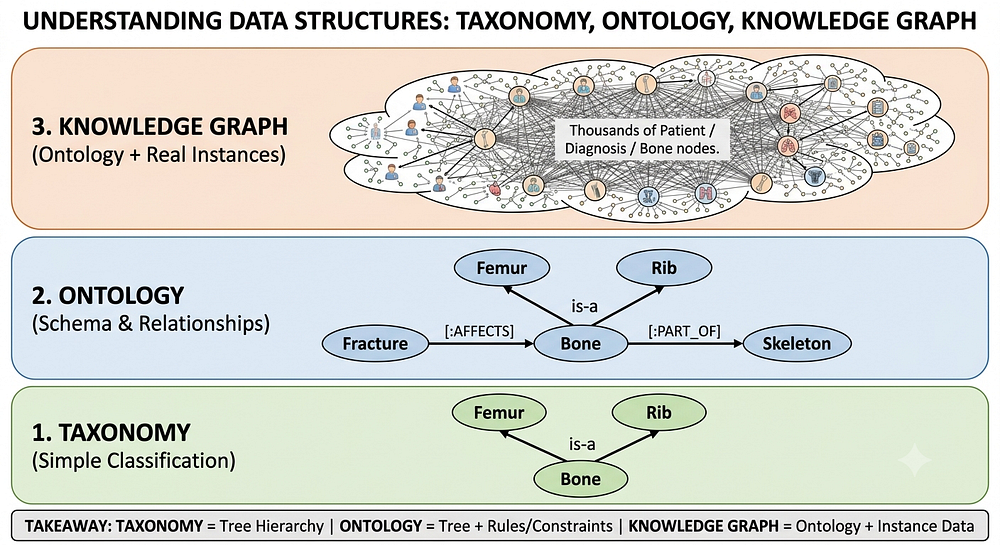
A taxonomy is a hierarchy. Parent, child, is-a. A tree of categories.
分類法 (taxonomy) 是一種階層。父、子、is-a(是一種)。一棵類別的樹。
An ontology adds relationships and rules on top of that hierarchy. Not just “a Femur is a Bone,” but “a Fracture affects a Bone” and “a Bone is part of a Skeleton,” with constraints on what can connect to what. It’s a formal model of a domain’s concepts and how they relate.
本體論 (ontology) 在該階層之上加入了關係與規則。不只是「股骨是一種骨頭」,還有「骨折會影響骨頭」以及「骨頭是骨骼的一部分」,並對什麼能連接到什麼加上約束。它是對一個領域的概念及其相互關係的形式化模型。
A knowledge graph is what you get when you populate an ontology with actual data. The ontology is the schema and the vocabulary; the graph is the millions of instances filling it in.
知識圖譜 (knowledge graph) 則是當你用實際資料填充一套本體論後所得到的東西。本體論是綱要 (schema) 與詞彙;圖譜則是填入其中的數百萬個實例。
That’s the whole reason the ontology matters. A property graph will happily run with almost no schema, and for plenty of jobs that’s the right call. But the moment you’re doing knowledge, structure stops being optional. Without an agreed model the same entity shows up under two labels, the same fact gets three different relationship types, and nobody can say which one is the real one. The ontology is what keeps a knowledge graph from drifting into a big pile of duplicated noise with edges.
這正是本體論之所以重要的全部原因。屬性圖 (property graph) 幾乎不需要綱要就能愉快地運作,而對許多工作而言這是正確的選擇。但一旦你要處理的是「知識」,結構就不再是可有可無。缺少一個共識模型,同一個實體會以兩個標籤出現,同一個事實會得到三種不同的關係型別,而沒有人能說出哪一個才是真的。本體論就是讓知識圖譜不至於漂移成一大堆帶著邊 (edge) 的重複雜訊的關鍵。
Press enter or click to view image in full size
按 Enter 或點擊以檢視完整尺寸圖片
data structures — generated with gemini
資料結構——以 gemini 生成
Healthcare and pharma: the most crowded shelf / 醫療與製藥:最擁擠的貨架
No domain has invested more in shared ontologies than medicine, mostly because getting a diagnosis wrong does real harm, and mislabeling a product photo does not.
沒有任何領域比醫學在共享本體論上投入更多,主要是因為診斷出錯會造成實質傷害,而把商品照片標錯則不會。
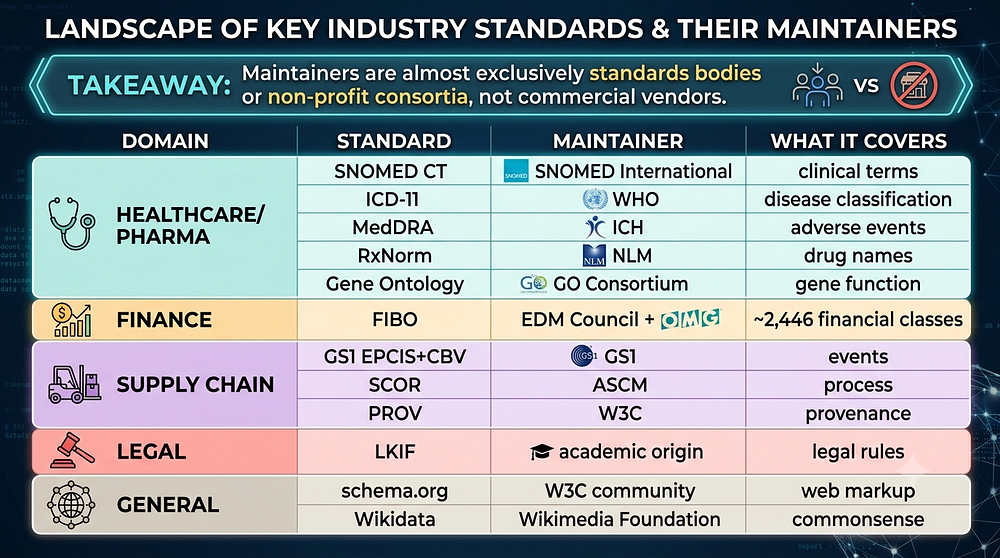
SNOMED CT is the big one for clinical terminology — diseases, findings, procedures, body structures, organisms, hundreds of thousands of concepts, coordinated by SNOMED International and used in over 50 countries. If you’re modeling anything a clinician records in an EHR, this is the reference vocabulary. It also publishes maps to other standards, which matters more than it sounds.
SNOMED CT 是臨床術語方面的巨頭——疾病、發現、處置、身體結構、生物體,數十萬個概念,由 SNOMED International 統籌,並在超過 50 個國家使用。如果你要為臨床醫師記錄在電子健康紀錄 (EHR) 中的任何東西建模,這就是參考詞彙。它還會發布與其他標準的對映,這比聽起來更重要。
ICD-11 is disease and cause-of-death classification, maintained by the World Health Organization and used for billing, epidemiology, and public health reporting across 150-plus countries. Where SNOMED CT is fine-grained clinical detail, ICD is the classification layer sitting above it. The two are related by explicit mappings, not merged.
ICD-11 是疾病與死因的分類,由世界衛生組織 (World Health Organization) 維護,用於超過 150 個國家的計費、流行病學與公共衛生通報。SNOMED CT 是細粒度的臨床細節,ICD 則是坐落其上的分類層。兩者透過明確的對映相互關聯,而非合併。
MedDRA is the one people outside pharma rarely hear about. Owned by the ICH — the regulators themselves — it’s the terminology for adverse events and drug safety monitoring (pharmacovigilance). When a drug safety report moves between a company and a regulator, it speaks MedDRA, and official SNOMED-to-MedDRA maps let clinical and regulatory data talk.
MedDRA 是製藥界以外的人鮮少聽聞的那一個。它由 ICH(即監管機構本身)所擁有,是用於不良事件與藥物安全監測(藥物警戒 (pharmacovigilance))的術語集。當一份藥物安全報告在公司與監管機構之間流轉時,它說的是 MedDRA,而官方的 SNOMED 對 MedDRA 對映讓臨床與法規資料得以對話。
RxNorm, from the US National Library of Medicine, normalizes drug names — the same medication sold under a dozen brand names collapses to one concept. The NLM also runs UMLS, the Metathesaurus that cross-maps SNOMED, ICD, RxNorm, and MedDRA — the nearest thing medicine has to a Rosetta Stone for its own vocabularies.
RxNorm 來自美國國家醫學圖書館 (US National Library of Medicine),它將藥品名稱標準化——同一種藥物即使以十幾個品牌名銷售,也會收斂成一個概念。NLM 也營運 UMLS,這套超級詞庫 (Metathesaurus) 對 SNOMED、ICD、RxNorm 與 MedDRA 進行交叉對映——是醫學界最接近其自身詞彙羅塞塔石碑 (Rosetta Stone) 的東西。
Gene Ontology is what a healthy, long-lived ontology looks like: gene function described through three linked pieces — the ontology, evidence-backed annotations, and causal models chaining them into pathways. As of mid-2025, it held over 1.1 million experimentally supported annotations from 185,000+ papers, maintained for two decades. Around it sits an ecosystem — the Human Phenotype Ontology, Mondo, the Monarch Initiative linking them across species.
基因本體論 (Gene Ontology) 展示了一套健康、長壽的本體論該有的樣子:以三個相互連結的部分描述基因功能——本體論本身、有證據支持的註釋,以及把它們串連成路徑的因果模型。截至 2025 年年中,它收錄了來自超過 185,000 篇論文、超過 110 萬條有實驗支持的註釋,並已維護二十年。圍繞它的是一整個生態系——人類表型本體論 (Human Phenotype Ontology)、Mondo,以及跨物種將它們連結起來的 Monarch Initiative。
That’s a whole stack of interlocking standards in one domain, mapped to each other on purpose. Ignore them and your medical KG becomes an island nobody else can query.
那是一整疊在同一領域中彼此咬合、刻意相互對映的標準。忽視它們,你的醫療知識圖譜就會變成一座沒有別人能查詢的孤島。
Finance: FIBO and the semantic operating system / 金融:FIBO 與語意作業系統
Finance has largely standardized on one thing: FIBO, the Financial Industry Business Ontology. It’s a joint effort between the EDM Council, which drives the design with major financial institutions, and the OMG, which handles governance and publishes it as a formal standard.
金融業大致上已在一件事上標準化:FIBO,即金融產業商業本體論 (Financial Industry Business Ontology)。它是 EDM Council 與 OMG 的合作成果——前者與各大金融機構共同推動設計,後者則負責治理並將其發布為正式標準。
The current production release carries roughly 2,446 classes spanning foundations, business entities, financial instruments, securities, and derivatives. Nobody reproduces 2,446 carefully-governed classes on a project deadline, and that’s the point: risk reporting, regulatory submissions, and increasingly agentic banking systems can all lean on the same vocabulary.
目前的正式發行版帶有約 2,446 個類別,涵蓋基礎概念、商業實體、金融工具、證券與衍生性商品。沒有人會在專案期限內重製 2,446 個經過審慎治理的類別,而這正是重點所在:風險報告、法規申報,以及日益走向代理化 (agentic) 的銀行系統,全都能倚靠同一套詞彙。
One writer called ontologies like FIBO the “semantic operating system” of modern banking. A bit much, maybe, but as banks wire up autonomous agents, a shared, machine-readable definition of a “counterparty” or a “collateral position” stops being nice-to-have.
有位作者把 FIBO 這類本體論稱為現代銀行業的「語意作業系統 (semantic operating system)」。也許有點誇張,但隨著銀行接上自主代理 (autonomous agent),一個對「交易對手 (counterparty)」或「擔保部位 (collateral position)」的共享、機器可讀定義,就不再只是錦上添花。
Supply chain: less one big ontology, more a stack of standards / 供應鏈:與其說是一套大本體論,不如說是一疊標準
Supply chain is a good counterexample to “every domain has one ontology.” Here you assemble a few.
供應鏈是「每個領域都有一套本體論」這說法的一個好反例。在這裡你得把好幾套組裝起來。
GS1 is the backbone — the organization behind the barcode. Its EPCIS standard plus the companion CBV (Core Business Vocabulary) is how companies share the what, when, where, why, and how of a product moving through a chain. Every scan event — shipped, received, inspected — lands in a common format another company reads the same way. For a traceability graph, EPCIS is the event vocabulary you want, and it maps cleanly onto a property graph because it’s already event-shaped.
GS1 是骨幹——就是條碼背後的那個組織。它的 EPCIS 標準加上配套的 CBV(核心商業詞彙 (Core Business Vocabulary)),是公司之間分享一件產品在鏈中流動時之「何物、何時、何地、為何、如何」的方式。每一個掃描事件——已出貨、已收貨、已檢驗——都落入一種共通格式,讓另一家公司能以相同方式解讀。對於一張可追溯性圖譜,EPCIS 正是你要的事件詞彙,而且因為它本來就是事件形狀,能乾淨地對映到屬性圖上。
SCOR (Supply Chain Operations Reference), now run by ASCM, is the model everyone uses in practice for the processes themselves — plan, source, make, deliver, return. Its 2025 Digital Standard built its information model on top of the W3C PROV ontology, the general-purpose vocabulary for provenance: who did what, to which thing, when. Provenance is exactly the question a knowledge graph answers well and a relational schema dreads.
SCOR(供應鏈作業參考模型 (Supply Chain Operations Reference)),現由 ASCM 營運,是眾人在實務上用來描述流程本身的模型——規劃、採購、製造、交付、退貨。它的 2025 年數位標準將其資訊模型建構在 W3C PROV 本體論之上,那是一套用於來源溯源 (provenance) 的通用詞彙:誰對哪樣東西、在何時做了什麼。來源溯源正是知識圖譜擅長回答、而關聯式綱要卻畏懼的問題。
Supply chain hasn’t settled on one big FIBO-style standard (there’s reference work like the IOF Supply Chain Ontology, but nothing dominant). You compose GS1 for identity and events, SCOR for process, PROV for provenance, and stitch them together — more assembly, but every piece is a standard someone else maintains.
供應鏈尚未定於一套像 FIBO 那樣的大標準(有像 IOF 供應鏈本體論 (IOF Supply Chain Ontology) 這類參考成果,但沒有一個佔主導地位)。你用 GS1 處理身分與事件、用 SCOR 處理流程、用 PROV 處理來源溯源,然後把它們縫合起來——組裝的功夫較多,但每一塊都是別人在維護的標準。
Law, and the general-purpose shelf / 法律,以及通用貨架
Legal is less settled. LKIF, the Legal Knowledge Interchange Format, models the legal domain explicitly — obligations, permissions, prohibitions, rules, the structures you need to reason about regulation rather than just store it. It’s more academic in origin than SNOMED or FIBO and adoption is patchier, which tells you something about how much harder “encode the law” is than “encode a drug list.”
法律領域則較不定案。LKIF,即法律知識交換格式 (Legal Knowledge Interchange Format),明確地為法律領域建模——義務、許可、禁止、規則,以及你在推理(而不只是儲存)法規時所需的結構。它的起源比 SNOMED 或 FIBO 更偏學術,採用情況也較零星,這告訴你「把法律編碼」比「把藥物清單編碼」要困難得多。
When nothing domain-specific fits, there’s the general-purpose layer — schema.org for generic People/Organizations/Places/Products, Wikidata for linking entities against a commonsense graph. Shallow, but useful glue.
當沒有任何領域專屬的東西合用時,還有通用層——schema.org 用於通用的人物/組織/地點/產品,Wikidata 用於把實體連結到一張常識圖譜上。雖然淺,但是好用的黏合劑。
One pattern across all of them / 貫穿所有這些的一個共通模式
Notice who maintains these: the WHO, a consortium of regulators, the NLM, nonprofit standards bodies, academic consortia on public grants. Almost none are vendor products. That’s why they’re safe to build on — not a feature that gets deprecated when a company pivots, but infrastructure: slow, governed, boring in the best way, outliving any single product roadmap.
留意一下是誰在維護這些:世界衛生組織、一個由監管機構組成的聯盟、NLM、非營利的標準機構、靠公共經費運作的學術聯盟。它們幾乎沒有一個是廠商產品。這正是為何在它們之上建構是安全的——它們不是某家公司轉向時就會被棄用的功能,而是基礎設施:緩慢、受治理、以最好的方式「無聊」,比任何單一產品的路線圖都活得更久。
Press enter or click to view image in full size
按 Enter 或點擊以檢視完整尺寸圖片
industry standards — generated with gemini
產業標準——以 gemini 生成
So when do you reuse, and when do you build? / 那麼,何時重用,何時自建?
This is the actual decision, and “always reuse” is wrong as often as “always build.” Drop the idea that reuse means importing everything — most of the time it means taking the slice that fits and leaving the rest on the shelf.
這才是真正的決策,而「永遠重用」和「永遠自建」一樣經常是錯的。拋開「重用就等於全部匯入」的想法吧——多數時候,重用意味著取用合適的那一片,把其餘留在貨架上。
Reuse a standard when:
在以下情況重用標準:
-
You’re in a regulated or interoperable domain. If your data will ever be exchanged, audited, or mapped to another system, the standard vocabulary isn’t optional — a medical KG with its own invented diagnosis codes is one nobody can integrate.
-
你身處受監管或需互通的領域。如果你的資料將來會被交換、稽核,或對映到另一個系統,那麼標準詞彙就不是可有可無的——一個自創診斷代碼的醫療知識圖譜,是沒有人能整合的。
-
The concepts are stable. “Drug,” “diagnosis,” “security” have been argued to death already; you won’t out-model the ICH on adverse events.
-
這些概念是穩定的。「藥物」、「診斷」、「證券」早已被爭論到爛;在不良事件的建模上,你贏不過 ICH。
-
You want governance for free — someone else maintains versions, handles deprecations, publishes mappings. That’s real labor you’re offloading.
-
你想要免費的治理——由別人來維護版本、處理棄用、發布對映。那是你正在卸下的實實在在的勞動。
Build (or extend) when:
在以下情況自建(或擴充):
-
Your domain is genuinely novel or narrow. Sports play-by-play events, a proprietary manufacturing process, an internal product taxonomy. No committee has standardized these, and forcing them into schema.org loses everything interesting.
-
你的領域確實新穎或狹窄。運動的逐球逐播事件、某個專有的製造流程、某套內部產品分類法。沒有委員會為這些制定標準,硬把它們塞進 schema.org 會失去一切有趣之處。
-
The concepts you need genuinely don’t exist in any standard — not just that the standard is big. Bigness alone isn’t a build trigger. Pulling 2,446 FIBO classes into a graph that needs forty is a maintenance tax, but the fix is a curated slice of those forty, not a schema of your own.
-
你所需要的概念確實不存在於任何標準中——而不只是因為標準很龐大。單憑龐大並不構成自建的理由。把 2,446 個 FIBO 類別拉進一張只需要四十個類別的圖裡是一種維護稅,但解方是精選那四十個類別的一片,而非另起一套你自己的綱要。
-
You need to move fast on a closed system. If the KG never leaves your walls and never integrates outward, the interoperability argument evaporates, and a lean custom model wins.
-
你需要在一個封閉系統上快速推進。如果這張知識圖譜永遠不會離開你的高牆、永遠不會對外整合,互通性的論點便煙消雲散,此時一個精簡的客製模型勝出。
The move that usually works is a hybrid, and you rarely take all of it. You take the slice that covers your concepts, curate it, extend it where your domain is special, and keep the standard’s identifiers so you can map outward later. For a narrow problem, that slice can be tiny. A KG that only answers drug-interaction questions doesn’t need all of SNOMED CT — a few hundred well-curated concepts, aligned to its codes, beat the whole thing dumped in and never looked at. The value was never the size. It’s that the piece you borrowed already agrees with everyone else’s.
通常行得通的做法是混合式,而你很少會全盤照收。你取用涵蓋你所需概念的那一片,加以精選,在你領域特殊之處予以擴充,並保留標準的識別碼,好讓你日後能對外對映。對於一個狹窄的問題,那一片可以非常小。一個只回答藥物交互作用問題的知識圖譜,並不需要整套 SNOMED CT——幾百個精心策劃、對齊其代碼的概念,勝過把整套倒進去卻從不過目。價值從來不在於大小,而在於你借來的那一塊早已與其他所有人的一致。
The temptation on a live knowledge graph project is always to model from scratch because it feels cleaner. It rarely is. Clean custom schemas are how you end up privately reinventing SNOMED, one node label at a time.
在一個實際運作的知識圖譜專案裡,總會有一股誘惑想從頭建模,因為那感覺比較乾淨。但它很少真的乾淨。乾淨的客製綱要,正是你如何一次一個節點標籤地私下重新發明 SNOMED 的過程。
The part that’s harder than it looks / 比看起來更難的那一部分
Reuse is the right default, but it isn’t free. A few things bite.
重用是正確的預設選項,但它並非免費。有幾件事會反咬你。
Curation is the real work. Even after you’ve picked your slice, someone has to keep it current. Standards deprecate concepts, split them, remerge them. A curated subset only beats the full import if you actually maintain it — refresh it on a schedule, re-check the concepts you depend on, prune what you dropped. Skip that and your “curated” slice is just a stale one.
策劃才是真正的工作。 即使你已選好那一片,仍得有人讓它保持最新。標準會棄用概念、拆分它們、再重新合併。一個精選子集唯有在你真的去維護它時,才勝過完整匯入——依排程更新它、重新檢查你所依賴的概念、修剪你捨棄的部分。略過這些,你那「精選」的一片就只是過時的一片。
Mapping is where the work hides. SNOMED-to-MedDRA, ICD-to-SNOMED, your extensions to the standard — these exist because concepts almost never line up one-to-one. Maintaining them is ongoing, and a subtly wrong mapping is worse than none: now you trust a link that’s lying to you.
對映是工作藏身之處。 SNOMED 對 MedDRA、ICD 對 SNOMED、你對標準所做的擴充——這些之所以存在,是因為概念幾乎從不會一對一對齊。維護它們是持續不斷的工作,而一個細微出錯的對映比沒有還糟:如今你信任的是一條在對你說謊的連結。
Fit is never perfect. A standard encodes someone else’s view of the domain — granularity you don’t want, gaps where your use case lives. Extending it without breaking what makes it a standard takes more understanding than building fresh, not less. Reuse trades modeling work for understanding work. Usually worth it. Not free.
契合永遠不會完美。 一套標準編碼的是別人對該領域的看法——有你不想要的粒度,也有你使用情境所在之處的缺口。在不破壞其所以成為標準的前提下擴充它,所需要的理解比從頭建構更多,而非更少。重用是拿建模的工作去換取理解的工作。通常值得,但並非免費。
And loading an ontology is not the same as reasoning with it. RDFS and OWL come with formal semantics and inference; property graphs often flatten that into labels and relationships and drop the logic. If you needed the reasoning, check you didn’t leave it at the door.
而且,載入一套本體論並不等同於用它來推理。RDFS 與 OWL 帶有形式化語意 (formal semantics) 與推論;屬性圖往往把那些壓扁成標籤與關係,並丟掉了邏輯。如果你需要那份推理能力,請檢查你沒有把它遺留在門口。
My thoughts / 我的想法
The domains furthest along with knowledge graphs, medicine and finance, are exactly the ones with mature shared ontologies. And that’s not a coincidence. The ontology is the on-ramp, and it’s why a healthcare KG built by one team can talk to a healthcare KG built by another that never met them.
在知識圖譜上走得最遠的領域——醫學與金融——正好就是擁有成熟共享本體論的那些。而這並非巧合。本體論是那條匝道,也是為何某個團隊打造的醫療知識圖譜,能與另一個素未謀面的團隊所打造的醫療知識圖譜對話的原因。
I’d still be careful not to turn “reuse standards” into dogma. Half of what makes a knowledge graph valuable could be the part nobody has standardized — that’s the part your competitors haven’t modeled either. The standard gets you interoperable. Your extensions get you interesting. Knowing which half you’re on at any moment is most of the skill.
我仍會小心,不把「重用標準」變成教條。讓一張知識圖譜有價值的原因,有一半可能正是沒有人標準化過的那部分——那也是你的競爭對手同樣沒有建模的部分。標準讓你能互通,你的擴充讓你變得有趣。在任何時刻都清楚自己身處哪一半,就是這門技藝的大半。
The one I’d actually bet on is agents. As more teams wire them onto their graphs, the value of a shared, machine-readable vocabulary goes up, not down. An agent reasoning over FIBO-grounded data is standing on 2,446 classes of built-up agreement about what the words mean. An agent reasoning over a schema someone invented last sprint is standing on vibes.
我真正會押注的是代理 (agent)。隨著越來越多團隊把它們接上自己的圖譜,一套共享、機器可讀詞彙的價值只會上升,不會下降。一個在以 FIBO 為基礎的資料上推理的代理,站的是 2,446 個類別、關於這些詞彙意義的累積共識之上。一個在某人上個衝刺 (sprint) 才發明的綱要上推理的代理,站的是「感覺」之上。
So before your next KG project, spend an afternoon on one question: does my domain already have an ontology? If it does, adopting even part of it will probably teach you more about your own data than a month of modeling from scratch. If it doesn’t, now you know you’re breaking new ground — a much more fun problem to have.
所以,在你下一個知識圖譜專案之前,花一個下午思考一個問題:我的領域是否早已有一套本體論?如果有,即使只採用它的一部分,也大概會比你花一個月從頭建模更能讓你了解自己的資料。如果沒有,那麼現在你知道自己正在開疆闢土——這是個有趣得多的問題。
Resources / 資源
-
Taxonomy vs. ontology vs. knowledge graph, Neo4j blog (June 2026): https://neo4j.com/blog/
-
分類法 vs. 本體論 vs. 知識圖譜,Neo4j 部落格(2026 年 6 月):https://neo4j.com/blog/
-
SNOMED International and SNOMED CT maps: https://www.snomed.org/maps
-
SNOMED International 與 SNOMED CT 對映:https://www.snomed.org/maps
-
MedDRA and its mappings: https://www.meddra.org/mapping
-
MedDRA 及其對映:https://www.meddra.org/mapping
-
RxNorm, US National Library of Medicine: https://www.nlm.nih.gov/research/umls/rxnorm/
-
RxNorm,美國國家醫學圖書館:https://www.nlm.nih.gov/research/umls/rxnorm/
-
ICD-11, World Health Organization: https://icd.who.int/
-
ICD-11,世界衛生組織:https://icd.who.int/
-
The Gene Ontology knowledgebase in 2026 (PMC): https://pmc.ncbi.nlm.nih.gov/articles/PMC12807639/
-
2026 年的基因本體論知識庫(PMC):https://pmc.ncbi.nlm.nih.gov/articles/PMC12807639/
-
FIBO, EDM Council: https://edmcouncil.org/financial-industry-business-ontology/
-
FIBO,EDM Council:https://edmcouncil.org/financial-industry-business-ontology/
-
FIBO specification (OMG): https://spec.edmcouncil.org/fibo/
-
FIBO 規格(OMG):https://spec.edmcouncil.org/fibo/
-
GS1 EPCIS & CBV (supply chain visibility): https://www.gs1.org/standards/epcis
-
GS1 EPCIS 與 CBV(供應鏈可視性):https://www.gs1.org/standards/epcis
-
SCOR Digital Standard, ASCM (2025): https://www.ascm.org/corporate-transformation/standards-tools/scor-ds/
-
SCOR 數位標準,ASCM(2025 年):https://www.ascm.org/corporate-transformation/standards-tools/scor-ds/
-
W3C PROV provenance ontology: https://www.w3.org/TR/prov-overview/
-
W3C PROV 來源溯源本體論:https://www.w3.org/TR/prov-overview/
-
IOF Supply Chain Reference Ontology: https://labs.engineering.asu.edu/semantics/ontology-download/iof-reference-ontologies/iof-supply-chain-structure/
-
IOF 供應鏈參考本體論:https://labs.engineering.asu.edu/semantics/ontology-download/iof-reference-ontologies/iof-supply-chain-structure/
-
Financial Regulation Ontology and LKIF references: https://finregont.com/reference-ontologies/
-
金融法規本體論 (Financial Regulation Ontology) 與 LKIF 參考資料:https://finregont.com/reference-ontologies/
-
“The Semantic Operating System for Modern Banking” (Medium): https://medium.com/@balajibal/the-semantic-operating-system-for-modern-banking-off-the-shelf-ontologies-1fc5cc83eb18
-
〈現代銀行業的語意作業系統〉(Medium):https://medium.com/@balajibal/the-semantic-operating-system-for-modern-banking-off-the-shelf-ontologies-1fc5cc83eb18
🔤 關鍵術語
| 英文 | 繁中譯名 | 文章中的脈絡 / 簡短說明 |
|---|---|---|
| Ontology | 本體論/本體 | 在分類階層之上加入關係與規則的領域形式化模型,是知識圖譜的 schema 與詞彙 |
| Taxonomy | 分類法 | 純粹的階層樹(parent/child/is-a),只有分類沒有關係規則 |
| Knowledge Graph (KG) | 知識圖譜 | 以實際資料填充本體後得到的產物,本體是 schema、圖譜是數百萬個實例 |
| Property Graph | 屬性圖 | 幾乎不需 schema 也能運作的圖資料模型,與 EPCIS 等事件式資料契合 |
| SNOMED CT | SNOMED 臨床術語 | 臨床術語標準(疾病、發現、程序、身體結構),逾 50 國使用 |
| ICD-11 | 國際疾病分類第十一版 | WHO 維護的疾病與死因分類,位於 SNOMED 之上的分類層 |
| MedDRA | 醫學法規事務詞典 | ICH 所有,用於不良事件與藥物安全監測(pharmacovigilance)的術語 |
| RxNorm | RxNorm 藥品標準命名 | 美國 NLM 出品,將同一藥物的多個品牌名正規化為單一概念 |
| UMLS / Metathesaurus | 統一醫學語言系統/超級詞庫 | NLM 維護,交叉映射 SNOMED、ICD、RxNorm、MedDRA 的「羅塞塔石」 |
| Gene Ontology | 基因本體論 | 以本體、證據標註、因果模型三部分描述基因功能,維護逾二十年 |
| FIBO | 金融產業商業本體 | EDM Council 與 OMG 共同治理,約 2,446 個類別的金融領域標準 |
| EPCIS / CBV | 電子產品碼資訊服務/核心商業詞彙 | GS1 標準,記錄產品流動的 what/when/where/why/how 事件格式 |
| SCOR | 供應鏈作業參考模型 | ASCM 維運的流程模型(plan/source/make/deliver/return) |
| W3C PROV | W3C 溯源本體 | 通用溯源詞彙(誰對何物做了什麼、何時),SCOR 資訊模型的基礎 |
| Provenance | 溯源 | 追溯資料來源與變更歷程,知識圖譜擅長回答、關聯式綱要難以處理 |
| LKIF | 法律知識交換格式 | 建模法律領域的義務、許可、禁止與規則,較學術、採用度較分散 |
| schema.org | schema.org 通用綱要 | 通用的人/組織/地點/產品本體,作為缺乏領域標準時的黏合層 |
| RDFS / OWL | RDF 綱要/網路本體語言 | 具形式語意與推論能力,屬性圖常將其扁平化而丟失邏輯 |
| Inference / Formal Semantics | 推論/形式語意 | 本體不只是載入,還能據以推理;若需推論須確認未在轉換中遺失 |
| Agentic Systems / Agents | 代理式系統/智能代理 | 作者最看好的方向:代理在 FIBO 等共享詞彙上推理,勝過臨時發明的 schema |