本體漂移——為何你的知識圖譜正悄悄出錯
文章資訊
作者:Alexander Shereshevsky 日期:2026-07-03
原文標題:Ontology Drift: Why Your Knowledge Graph Is Slowly Going Wrong
📝 重點摘要
TL;DR
知識圖譜真正的殺手不是建置,而是本體與現實逐漸脫節的「本體漂移」。
核心問題
產業界大量研究如何「建置」知識圖譜,卻幾乎無人關注「維護」。當本體(schema)保持凍結、而業務領域持續演變,圖譜會在不報錯的情況下慢慢給出更差的答案。作者將此現象命名為 ontology drift,並主張這是企業 KG 專案無法持續產出價值的最大原因。
關鍵發現 / 數據
- KG 生產部署率兩年幾乎停滯:2024 約 26%、2025 約 27%,儘管建置成本大降(LightRAG 降 6,000 倍、schema 引導抽取精度達 98.8%)。
- Wikidata 有 740 條 disjoint union 宣告、涵蓋 603 類,衍生 6,995 對隱含互斥類別,被實際資料常態性違反。
- SNOMED CT 含 37 萬類名、每年更新兩次;語意型別錯誤率從 <1% 到 physical force 階層 33%、record artifact 階層 62.5%。
- Pernisch 等人(ESWC 2024)分析 17 個真實 KG 專案,發現全都處理資料攝取,卻「完全未考慮本體演化」。
方法亮點
- 借用 ML 的 concept drift 框架,將漂移分為 sudden/gradual/incremental/recurring 四型,並歸納為實體型別、關係、約束三類漂移。
- 偵測訊號:抽取精度下滑、查詢語意失敗率上升、圖結構指標(孤點率、型別分布);主張持續自動化監控(SemaDrift 三維度)。
- 治理原則:版本化而非替換、為維運(curation)編列預算、增量更新(LightRAG 省 50% 成本)、LLM 輔助但人類把關。
對我的研究有用嗎?
相當有用。將 concept drift 的成熟監控範式遷移到 GraphRAG,是一個可操作的研究縫隙——尤其「抽取精度趨勢作為 schema-資料對齊指標」可直接納入 GraphRAG 評測。Wikidata/SNOMED 的量化錯誤率、LOT4KG 的空白,都是引用價值高的實證。可延伸研究:本體演化下 retrieval 品質退化的因果歸因,以及 LLM 輔助 schema 演化(AIO、MILA depth-first)。
評語
值得一讀的觀點文(opinion/綜述性質,非實驗論文);命名清晰、引用扎實,但無自有 benchmark,結論偏倡議性,數據多為二手引用,需回溯原始出處核實。
🌐 中英對照
Author: Alexander Shereshevsky Published: Source: https://medium.com/graph-praxis/ontology-drift-why-your-knowledge-graph-is-slowly-going-wrong-234fa238826c Fetched: 2026-07-03T00:39:10.422584
Ontology Drift: Why Your Knowledge Graph Is Slowly Going Wrong / 本體漂移:為什麼你的知識圖譜正在悄悄出錯
Press enter or click to view image in full size
按 Enter 或點擊以檢視完整尺寸的圖片
Everyone talks about building knowledge graphs. Nobody talks about what happens when the ontology that governs them stops matching reality. Here's why ontology drift is the silent killer of enterprise KG projects — and what the field needs to do about it.
每個人都在談論如何建構知識圖譜 (Knowledge Graph)。卻沒有人談論當統管這些圖譜的本體論 (Ontology) 不再與現實相符時會發生什麼。這就是為什麼本體漂移 (Ontology Drift) 是企業級知識圖譜 (KG) 專案的隱形殺手——以及這個領域該對此採取什麼行動。
There's a number that should bother everyone in the knowledge graph community: 27%. That's the share of organizations that have knowledge graphs in production as of late 2025, according to Google Cloud's survey. A year earlier, it was 26%. Essentially flat — in a year where Graph RAG papers flooded every major conference, when Microsoft, NVIDIA, and Apple all published ontology-grounded retrieval research, when Gartner issued over 35 reports referencing knowledge graphs for context-aware AI.
有一個數字應該讓知識圖譜社群中的每個人感到不安:27%。根據 Google Cloud 的調查,這是截至 2025 年底已將知識圖譜投入生產環境的組織比例。一年前,這個數字是 26%。基本上停滯不前——而這一年裡,圖 RAG (Graph RAG) 的論文淹沒了每一場重要會議,微軟、NVIDIA 和 Apple 都發表了以本體為基礎的檢索研究,Gartner 也發布了超過 35 份提及知識圖譜用於情境感知 AI 的報告。
The technology is maturing rapidly. Adoption isn't. And the usual explanations — "it's too expensive," "the tooling isn't there," "we need better models" — are starting to ring hollow. LightRAG cut construction costs by 6,000x. Graph databases ship native vector indexing. LLMs can extract entities and relationships from unstructured text with 98.8% precision when provided with schema guidance. The building part is getting solved.
技術正在快速成熟。採用率卻沒有。而那些老套的解釋——「太貴了」、「工具還不成熟」、「我們需要更好的模型」——開始顯得空洞。LightRAG 將建構成本削減了 6,000 倍。圖資料庫內建了原生向量索引。當提供結構描述 (schema) 指引時,大型語言模型 (LLM) 能以 98.8% 的精確度從非結構化文本中擷取實體與關係。建構的部分正逐漸被解決。
So why aren't more knowledge graphs making it to production? And here's the harder question — why are so many that do make it there quietly breaking?
那麼,為什麼沒有更多的知識圖譜進入生產環境?而更棘手的問題是——為什麼這麼多進入生產環境的知識圖譜正在悄悄崩壞?
Because everyone's focused on construction. Nobody's focused on maintenance.
因為每個人都專注於建構。沒有人專注於維護。
We think the underlying problem hasn't been properly named yet. We're calling it ontology drift: the gradual divergence between a knowledge graph's formal schema and the reality it's supposed to represent. The ontology says the world works one way; the world has moved on. No alarm fires. Queries still return results. The results just get slowly, invisibly worse.
我們認為這個根本問題還沒有被恰當地命名。我們稱之為本體漂移 (ontology drift):知識圖譜的形式化結構描述與它本應代表的現實之間逐漸產生的分歧。本體論說世界是這樣運作的;但世界已經往前走了。沒有警報響起。查詢仍然會回傳結果。只是結果緩慢地、無形地變糟。
This isn't a theoretical concern. It's the single biggest reason enterprise knowledge graph projects fail to deliver sustained value — and almost nobody is talking about it.
這不是理論上的憂慮。它是企業知識圖譜專案無法持續帶來價值的最大單一原因——而幾乎沒有人在談論它。
The Map Is Not the Territory (And the Territory Keeps Moving) / 地圖不是疆域(而且疆域一直在移動)
Alfred Korzybski's (Or Houellebecq's? — adding an easter egg here) famous observation — "the map is not the territory it represents" — captures the fundamental nature of ontologies. An ontology is a map: a formal declaration of the types of entities that exist in a domain, the relationships between them, and the constraints that govern those relationships. Like any map, its value depends entirely on how faithfully it represents the territory it describes.
阿爾弗雷德·柯日布斯基 (Alfred Korzybski)(還是韋勒貝克 (Houellebecq)?——在此加個彩蛋)著名的觀察——「地圖不是它所代表的疆域」——精準捕捉了本體論的根本性質。本體論就是一張地圖:對某個領域中存在的實體類型、它們之間的關係,以及統管這些關係的約束條件所做的形式化宣告。就像任何地圖一樣,它的價值完全取決於它多麼忠實地代表了它所描述的疆域。
The problem is that territories move. Business domains evolve. New product categories emerge. Regulatory frameworks change. Organizational structures reorganize. Customer behaviors shift. And the ontology — the map that was carefully designed to represent this domain six months or two years ago — stays frozen.
問題在於疆域會移動。業務領域會演變。新的產品類別會出現。監管框架會改變。組織結構會重組。客戶行為會轉變。而本體論——那張在六個月或兩年前被精心設計來代表這個領域的地圖——卻凍結不動。
This is a well-understood problem in adjacent fields. The machine learning community has spent decades studying concept drift — the phenomenon where the statistical properties of a model's target variable change over time, causing model performance to degrade. Tsymbal's foundational 2004 paper and Ditzler et al.'s 2015 IEEE survey identified four distinct patterns: sudden drift (abrupt changes), gradual drift (slow coexistence of old and new), incremental drift (tiny shifts that compound), and recurring drift (cyclical patterns).
這在相鄰領域是一個被充分理解的問題。機器學習社群花了數十年研究概念漂移 (concept drift)——即模型目標變數的統計特性隨時間改變,導致模型效能退化的現象。Tsymbal 於 2004 年的奠基性論文以及 Ditzler 等人於 2015 年的 IEEE 綜述辨識出四種不同的模式:突發漂移 (sudden drift,劇烈變化)、漸進漂移 (gradual drift,新舊緩慢並存)、增量漂移 (incremental drift,微小變化累積) 以及循環漂移 (recurring drift,週期性模式)。
Each of these maps is precisely tailored to ontology scenarios. A corporate acquisition triggers a sudden drift — "Competitor" entities become "Business Unit" entities overnight, and every relationship typed as "competes_with" is now wrong. A new technology category (e-sports, cryptocurrency, autonomous vehicles) creates a gradual drift — the old categories still apply to most cases, but an expanding frontier doesn't fit. Incremental drift is the most insidious: individual customers slowly acquire attributes — wholesale purchasing patterns, reseller agreements, multi-region operations — that strain their type definitions, until the types themselves no longer describe coherent categories. Recurring drift appears in seasonal business patterns — fiscal year boundaries, product launch cycles, regulatory reporting periods — where the schema periodically misaligns with operational reality.
這其中每一種模式都精確地對應到本體論的情境。一場企業收購觸發突發漂移——「競爭對手」實體一夜之間變成「業務單位」實體,而每一個被標記為「competes_with(與……競爭)」的關係現在都錯了。一個新的技術類別(電子競技、加密貨幣、自動駕駛車輛)造成漸進漂移——舊的類別仍然適用於大多數案例,但不斷擴張的前沿卻不再契合。增量漂移是最陰險的:個別客戶慢慢地取得了新屬性——批發採購模式、經銷商協議、跨地區營運——這些屬性讓他們的類型定義備受壓力,直到類型本身不再描述一致連貫的類別。循環漂移出現在季節性的業務模式中——會計年度的界線、產品發布週期、監管申報期間——在這些情況下,結構描述會週期性地與營運現實錯位。
The machine learning community developed robust monitoring and remediation practices for concept drift. The knowledge graph community has not done the equivalent for ontology drift. And the consequences are becoming impossible to ignore.
機器學習社群為概念漂移發展出了健全的監控與修復實務。知識圖譜社群卻沒有為本體漂移做出對等的努力。而其後果正變得無法忽視。
Three Types of Ontology Drift / 本體漂移的三種類型
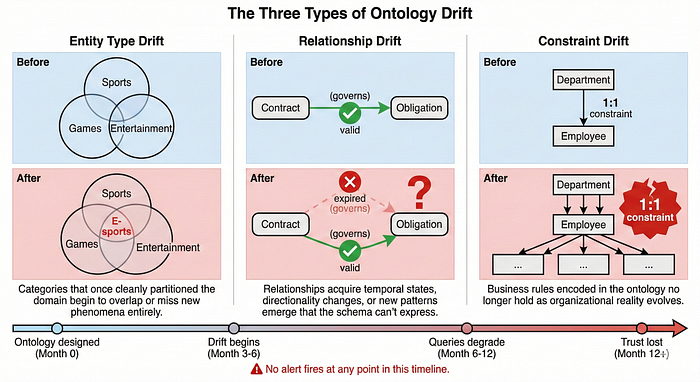
In practice, ontology drift manifests in three distinct but interacting forms. Understanding which type you're dealing with determines whether the fix is a schema update, a data migration, or a fundamental re-architecture.
在實務中,本體漂移以三種不同但相互作用的形式呈現。理解你正在處理的是哪一種類型,將決定修復方法是結構描述更新、資料遷移,還是根本性的重新架構。
Entity type drift occurs when the categories that define your ontology no longer cleanly partition the domain. Google's published research on industry-scale knowledge graphs provides the canonical example: when they originally defined "sports" as a type in their Knowledge Graph, e-sports didn't exist. As competitive gaming grew into a billion-dollar industry with professional leagues, broadcast deals, and athlete visas, the type system faced a question it wasn't designed for. E-sports shares some properties with traditional sports (competition, leagues, audiences) but lacks others (physical exertion, outdoor venues). Do you stretch the definition of "sports" and risk polluting queries that expect physical athletics? Create a new type and lose the connections to the competition/league/audience infrastructure? Merge the two and accept that downstream consumers will encounter unexpected results?
實體類型漂移 (Entity type drift) 發生於定義你本體論的類別不再能乾淨俐落地劃分整個領域時。Google 發表的關於產業規模知識圖譜的研究提供了典型範例:當他們最初在其知識圖譜中將「運動 (sports)」定義為一個類型時,電子競技還不存在。隨著競技遊戲成長為一個擁有職業聯賽、轉播合約和運動員簽證的數十億美元產業,這個類型系統面臨了它並非為此設計的問題。電子競技與傳統運動共享某些屬性(競賽、聯賽、觀眾),卻缺乏其他屬性(體力消耗、戶外場地)。你是要延展「運動」的定義,冒著污染那些預期是體能運動的查詢的風險?還是建立一個新類型,卻失去與競賽/聯賽/觀眾基礎架構的連結?還是將兩者合併,並接受下游消費者將會遭遇非預期的結果?
This isn't an edge case. It's the default trajectory of any ontology operating in an evolving domain. You can see it in my experiments with knowledge graph extraction from Homer's Iliad: the open-domain extractor created DEITY, GOD, and GODDESS as distinct entity types — not because the text demanded it, but because the extraction process had no schema to tell it these were the same concept at different levels of specificity. In a production system, this fragmentation doesn't announce itself. It just silently fractures the graph.
這不是一個邊緣案例。它是任何在演變中的領域裡運作的本體論的預設軌跡。你可以在我從荷馬 (Homer)《伊利亞德 (Iliad)》中擷取知識圖譜的實驗中看到這一點:開放領域 (open-domain) 擷取器建立了 DEITY(神祇)、GOD(男神)和 GODDESS(女神)作為不同的實體類型——並非因為文本要求如此,而是因為擷取過程沒有結構描述來告訴它這些在不同特定程度上其實是同一個概念。在生產系統中,這種碎片化不會主動宣告自己。它只是悄悄地讓圖譜產生裂痕。
Relationship drift occurs when the connections between entity types change — either because valid relationships are no longer represented, or because new relationship patterns emerge that the schema can't express. This is particularly dangerous in temporal domains. A valid contract becomes expired, but if the ontology doesn't distinguish temporal states of relationships, the graph treats the expired contract the same as the active one. Adding new relationship types without backfilling creates missed links — queries over the new type return incomplete results because historical data was never mapped to it.
關係漂移 (Relationship drift) 發生於實體類型之間的連結改變時——要麼是因為有效的關係不再被表達,要麼是因為出現了結構描述無法表達的新關係模式。這在時間性領域中尤其危險。一份有效的合約變成過期,但如果本體論不區分關係的時間狀態,圖譜就會將過期的合約與有效的合約一視同仁。在不回填 (backfilling) 的情況下新增關係類型會造成遺漏的連結——針對新類型的查詢會回傳不完整的結果,因為歷史資料從未被對應到它上面。
Constraint drift occurs when the business rules encoded in the ontology no longer hold. An ontology constraint that "every Employee belongs to exactly one Department" breaks when the organization moves to a matrix structure. A constraint that "every Product has a single Category" fails when product bundles span categories. Wikidata — the world's largest collaboratively edited knowledge graph — currently has 740 disjoint union statements across 603 classes, creating 6,995 implied disjoint class pairs that are routinely violated by the actual data. Each violation means the ontology claims two types of things cannot overlap, while the data contains entities that belong to both. This isn't sloppy data entry. It's a schema that no longer matches the world it describes. And it happens everywhere: a SaaS company's ontology says a "Customer" and a "Partner" are disjoint types — until the day a customer becomes a reseller, and the entire downstream reporting pipeline produces contradictory results.
約束漂移 (Constraint drift) 發生於本體論中編碼的業務規則不再成立時。「每位員工恰好隸屬於一個部門」這條本體論約束,在組織轉為矩陣式結構時就會失效。「每項產品有單一類別」這條約束,在產品組合橫跨多個類別時就會失敗。Wikidata——世界上最大的協作編輯知識圖譜——目前在 603 個類別之間有 740 條不相交聯集 (disjoint union) 陳述,創造出 6,995 對隱含的不相交類別配對,而這些配對經常被實際資料所違反。每一次違反都意味著本體論宣稱兩種事物不能重疊,然而資料中卻包含同時屬於兩者的實體。這不是草率的資料輸入。而是一個不再與它所描述的世界相符的結構描述。而且這種情況無所不在:一家 SaaS 公司的本體論說「客戶 (Customer)」和「合作夥伴 (Partner)」是不相交的類型——直到某一天,一個客戶變成了經銷商,而整條下游報告流程產生了自相矛盾的結果。
Press enter or click to view image in full size
按 Enter 或點擊以檢視完整尺寸的圖片
The Evidence: What Drift Looks Like at Scale / 證據:漂移在規模化下的樣貌
The most compelling evidence for ontology drift comes not from theoretical arguments but from the organizations operating the world's largest knowledge graphs. Their experiences paint a consistent picture: schema maintenance is harder, more expensive, and more consequential than anyone anticipated.
支持本體漂移最有力的證據並非來自理論論證,而是來自營運著世界上最大知識圖譜的組織。它們的經驗描繪出一幅一致的圖像:結構描述的維護比任何人所預期的都更困難、更昂貴、也更事關重大。
Google — whose Knowledge Graph underpins Search, Assistant, and a range of AI products — published that managing consistency on a large evolving knowledge graph while handling fast incremental updates is "fundamentally difficult." Their solution involves a multilayered metamodel architecture in which the lower layers remain constant while higher levels evolve through metatypes. In other words, they engineered around drift by creating layers of abstraction. Most organizations don't have Google's engineering resources to do this.
Google——其知識圖譜支撐著搜尋、助理以及一系列 AI 產品——公開表示,在處理快速增量更新的同時管理一個大型演變中知識圖譜的一致性是「根本性地困難」。他們的解決方案涉及一個多層次的元模型 (metamodel) 架構,其中較低的層次保持恆定,而較高的層次則透過元類型 (metatypes) 演變。換句話說,他們透過建立多層抽象來繞開漂移進行工程設計。大多數組織並不具備 Google 的工程資源來做到這一點。
Wikidata provides perhaps the most quantified case study of drift at scale. A recent analysis ("Diagnosing and Mitigating Semantic Inconsistencies in Wikidata's Classification Hierarchy") evaluated over 4 million subclassed entities and found pervasive semantic ambiguity. The 740 disjoint union violations aren't a data quality problem — they're an ontology design problem. The classification hierarchy was built to reflect one model of the world; the world diversified beyond that model. Critically, Wikidata's current infrastructure provides only limited mechanisms for detecting and remediating these constraint violations at scale — no automated reasoning, no systematic consistency checking. The drift accumulates largely invisibly to downstream consumers.
Wikidata 提供了或許是規模化漂移最量化的案例研究。一份近期分析(〈診斷與緩解 Wikidata 分類階層中的語意不一致性〉)評估了超過 400 萬個子類別化的實體,並發現了普遍存在的語意模糊性。那 740 條不相交聯集的違反並非資料品質問題——而是本體論設計問題。這個分類階層被建構來反映某一種世界模型;但世界的多樣化已超越了那個模型。關鍵在於,Wikidata 目前的基礎架構僅提供有限的機制來大規模偵測與修復這些約束違反——沒有自動化推理,沒有系統性的一致性檢查。這種漂移在很大程度上是在下游消費者無從察覺的情況下累積的。
SNOMED CT — the international clinical terminology used in electronic health records worldwide — offers a sobering lesson in what happens when ontologies grow through successive versions. SNOMED CT contains 370,000 class names and is updated twice yearly, with each release requiring manual semantic type assignment and review. Studies of its quality have found error rates ranging from under 1% in semantically consistent hierarchies to 33% in the physical force hierarchy and 62.5% in the record artifact hierarchy. These aren't typos or missing entries. They're semantic type errors — entities assigned to the wrong categories — introduced incrementally across versions. A Gene Ontology case study tracking 60 monthly releases found a monotonous increase in classes, relations, and structural complexity, with no mechanism for reduction or simplification. Ontologies, left to their own evolutionary dynamics, grow but don't self-correct.
SNOMED CT——全球電子健康紀錄中使用的國際臨床術語——為本體論透過連續版本成長時會發生什麼提供了一個發人深省的教訓。SNOMED CT 包含 370,000 個類別名稱,每年更新兩次,每次發布都需要手動指派語意類型並進行審查。對其品質的研究發現,錯誤率從語意一致階層中的低於 1%,到物理力階層中的 33%,以及紀錄產物階層中的 62.5%不等。這些不是打字錯誤或遺漏的條目。它們是語意類型錯誤——實體被指派到錯誤的類別——是跨版本增量地被引入的。一項追蹤基因本體論 (Gene Ontology) 60 個月度發布版本的案例研究發現,類別、關係和結構複雜度呈現單調增加,卻沒有任何縮減或簡化的機制。本體論若任其自身的演化動態發展,只會成長,卻不會自我修正。
AstraZeneca's biomedical knowledge graph (BIKG) illustrates drift in a multi-source integration context. The graph combines genomic, disease, drug, clinical, and safety data from sources including ChEMBL, Ensembl, Hetionet, and Open Targets, as well as internal NLP pipelines over unstructured publications. The documented challenge: once many data sources are integrated, problems multiply — especially with data updates. Entity disambiguation becomes acute because synonyms across sources refer to the same entity differently, while shared names may have different properties depending on context. Managing this highly dynamic data, the team reported, "poses greater challenges than point-in-time knowledge." The ontology must evolve with the combined pace of all its sources, not just one.
阿斯特捷利康 (AstraZeneca) 的生物醫學知識圖譜 (BIKG) 展示了在多來源整合情境下的漂移。這個圖譜結合了來自 ChEMBL、Ensembl、Hetionet 和 Open Targets 等來源的基因組學、疾病、藥物、臨床和安全性資料,以及針對非結構化出版品的內部自然語言處理 (NLP) 流程。有文件記載的挑戰是:一旦整合了眾多資料來源,問題就會倍增——尤其是在資料更新方面。實體消歧 (Entity disambiguation) 變得棘手,因為跨來源的同義詞以不同方式指稱同一個實體,而共享的名稱可能依情境不同而具有不同的屬性。該團隊回報說,管理這種高度動態的資料「比某一時間點的知識帶來更大的挑戰」。本體論必須隨著它所有來源的綜合步調演變,而不僅僅是其中一個。
And then there's the finding that, for us, tied everything together. Romana Pernisch and colleagues, in a 2024 paper presented at ESWC, analyzed 17 published real-world knowledge graph projects and found that while continuous data digestion is accounted for in most implementations, ontology evolution and its impact on engineered KGs are not considered at all. The data flows in. The schema is treated as permanent. Until it fails.
然後有一項發現,對我們而言,將一切串連了起來。Romana Pernisch 及其同事在 2024 年 ESWC 發表的一篇論文中,分析了 17 個已發表的真實世界知識圖譜專案,並發現雖然大多數實作都考慮到了持續的資料消化,但本體論的演變及其對已建構知識圖譜的影響卻完全沒有被納入考量。資料源源不斷地流入。結構描述被視為永久不變的。直到它失效為止。
This is the research equivalent of discovering that an entire industry changes the oil in its engines but never replaces the timing belt.
這在研究上相當於發現整個產業都會更換引擎機油,卻從不更換正時皮帶。
Press enter or click to view image in full size
按 Enter 或點擊以檢視完整尺寸的圖片
Why Nobody Notices (Until It's Too Late) / 為什麼沒有人注意到(直到為時已晚)
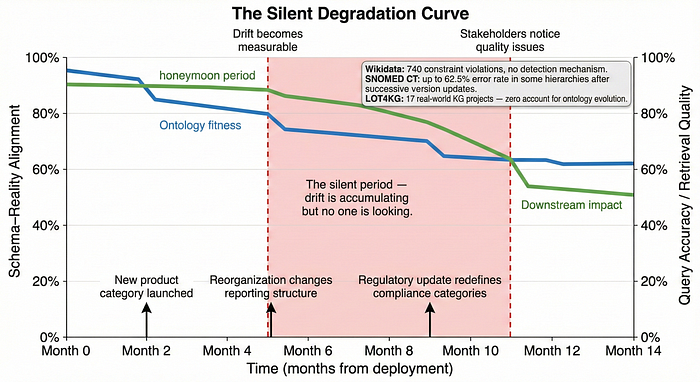
Ontology drift is uniquely dangerous because it produces no error messages. A knowledge graph with a drifting ontology still responds to queries. Cypher executes. SPARQL returns triples. The graph database health checks pass. CPU and memory look normal.
本體漂移之所以格外危險,是因為它不產生任何錯誤訊息。一個本體論正在漂移的知識圖譜仍然會回應查詢。Cypher 會執行。SPARQL 會回傳三元組 (triples)。圖資料庫的健康檢查會通過。CPU 和記憶體看起來都正常。
Yet the answers get worse — gradually, invisibly, in ways that are almost impossible to trace back to the schema. When a RAG system starts returning slightly less relevant results, the instinct is to blame the retrieval algorithm, the embedding model, or the chunk size. When an agent makes a subtly wrong recommendation, the instinct is to blame the prompt or the model. Almost nobody asks: "has the ontology drifted?"
然而答案卻越來越糟——緩慢地、無形地,以幾乎不可能追溯回結構描述的方式。當一個 RAG 系統開始回傳相關性略低的結果時,直覺是去怪罪檢索演算法、嵌入 (embedding) 模型,或是分塊 (chunk) 大小。當一個代理 (agent) 做出一個細微錯誤的建議時,直覺是去怪罪提示詞 (prompt) 或模型。幾乎沒有人問:「本體論漂移了嗎?」
This is compounded by three organizational dynamics.
這又因三種組織動態而加劇。
First, the people who built the ontology are rarely the people who maintain the system. The ontology design phase is typically a focused effort involving domain experts and knowledge engineers. Once the graph is built and deployed, those experts move on. The operations team that inherits the system understands the infrastructure — the database, the ETL pipelines, the API layer — but not the semantic assumptions baked into the schema. They can tell when the database is slow. They can't tell when the ontology is wrong.
第一,建構本體論的人,很少是維護系統的人。 本體論設計階段通常是一項涉及領域專家和知識工程師的集中投入。一旦圖譜被建構並部署,那些專家就轉往他處。接手系統的營運團隊理解基礎架構——資料庫、ETL 流程、API 層——卻不理解烘焙進結構描述裡的語意假設。他們能分辨資料庫何時變慢。他們卻分辨不出本體論何時出錯。
Second, ontology changes are politically expensive. Modifying a schema in production has cascading consequences: queries may break, dashboards may need to be updated, and downstream consumers may see unexpected results. The organizational incentive is to avoid schema changes, even when the schema is accumulating debt. This is Chesterton's Fence in action — don't modify the schema until you understand all the reasons it was designed this way. A rational instinct, but one that leads to paralysis when the world moves faster than the review process.
第二,本體論的變更在政治上代價高昂。 在生產環境中修改結構描述會有連鎖後果:查詢可能崩壞、儀表板可能需要更新,而下游消費者可能會看到非預期的結果。組織的誘因是避免結構描述變更,即使結構描述正在累積債務。這是切斯特頓的柵欄 (Chesterton's Fence) 的實際體現——在你理解結構描述被設計成這樣的所有理由之前,不要去修改它。這是一種理性的本能,但當世界移動的速度快過審查流程時,它就會導致癱瘓。
Third, and most subtle: Goodhart's Law applies to ontologies. When ontology categories become the basis for KPIs, dashboards, and reports, teams resist changes that would break their metrics — even when those metrics no longer measure what matters. The category "Enterprise Customer" was defined two years ago with specific criteria. The business has since introduced a "Strategic Partner" tier that overlaps with Enterprise but has different contractual terms. Nobody wants to split the type because it would invalidate two years of trend data.
第三,也是最微妙的:古德哈特定律 (Goodhart's Law) 適用於本體論。 當本體論的類別成為 KPI、儀表板和報告的基礎時,團隊會抗拒那些會破壞其指標的變更——即使那些指標已經不再衡量重要的事物。「企業客戶 (Enterprise Customer)」這個類別是兩年前以特定標準定義的。此後,該企業引入了一個與「企業」重疊但契約條款不同的「策略夥伴 (Strategic Partner)」層級。沒有人想要拆分這個類型,因為那會讓兩年的趨勢資料失效。
LinkedIn's engineering team bluntly captured this dynamic: "Most ontologies and knowledge graphs are notoriously brittle." Their conclusion — that all knowledge graphs must possess algorithms modeling dynamism, because stability is unachievable — is one that the broader industry has been slow to internalize.
LinkedIn 的工程團隊直白地道出了這種動態:「大多數本體論和知識圖譜出了名地脆弱。」他們的結論——所有知識圖譜都必須擁有能建模動態性的演算法,因為穩定性是無法達成的——是整個業界一直遲遲未能內化的一項結論。
Detecting Drift Before It Detects You / 在漂移偵測到你之前偵測它
The evidence is clear: ontology drift is universal, it's measurable, and it's largely unmonitored. But recognizing the problem is only useful if you can catch it before it destroys trust in your knowledge graph. So how do you detect drift early enough to act?
證據很清楚:本體漂移普遍存在、可被衡量,且大體上未被監控。但辨識出這個問題,唯有當你能在它摧毀對你知識圖譜的信任之前捕捉到它時,才有用處。那麼,你要如何早到足以採取行動地偵測漂移?
The machine learning community's approach to concept drift monitoring provides a direct blueprint. IBM, Google, and other MLOps practitioners track statistical properties of model inputs and outputs over time, triggering alerts when distributions shift beyond defined thresholds. The same logic applies to knowledge graphs — but the metrics are different.
機器學習社群對概念漂移監控的方法提供了一份直接的藍圖。IBM、Google 和其他 MLOps 從業者會隨時間追蹤模型輸入與輸出的統計特性,當分佈偏移超過既定閾值時就觸發警報。同樣的邏輯適用於知識圖譜——但衡量指標不同。
Extraction quality degradation is the earliest signal. If you're continuously extracting entities and relationships from incoming data (as most production KGs do), track the percentage of new entities that fit cleanly into existing types versus those that require forcing, splitting, or catch-all categories. When Apple's ODKE+ methodology achieves 98.8% precision in schema-guided extraction, that precision indicates alignment between the schema and the data. If your precision is trending downward — even if the extraction model hasn't changed — the schema is drifting away from the data.
擷取品質退化 (Extraction quality degradation) 是最早的訊號。如果你正持續地從流入的資料中擷取實體和關係(如大多數生產環境知識圖譜所做的那樣),就追蹤能乾淨俐落地契合現有類型的新實體,相對於那些需要硬套、拆分或使用萬用 (catch-all) 類別的新實體的百分比。當 Apple 的 ODKE+ 方法論在結構描述引導的擷取中達到 98.8% 的精確度時,那個精確度指示的是結構描述與資料之間的一致性。如果你的精確度正在向下走——即使擷取模型並未改變——那麼結構描述正在偏離資料。
Query failure patterns provide a second signal. Track empty result rates, unexpected null returns, and queries that return wrong-type results. A rising rate of queries that structurally succeed but semantically fail — returning technically valid but practically useless results — is a strong indicator that the ontology's categories no longer match how users think about the domain.
查詢失敗模式 (Query failure patterns) 提供了第二種訊號。追蹤空結果率、非預期的空值回傳,以及回傳錯誤類型結果的查詢。結構上成功但語意上失敗——回傳技術上有效卻實務上無用的結果——的查詢比率上升,是本體論的類別不再符合使用者對該領域思考方式的一個強烈指標。
Graph structural metrics offer a third signal. Monitor average entities per document, relationship density, orphan node rate, and confidence distribution at extraction time. The SemaDrift framework (Journal of Web Semantics, 2018) formalized three measurement dimensions for detecting semantic change: label aspect changes (names shifting), intension changes (concept definitions evolving), and extension changes (which things belong to which concepts). These can be operationalized as automated health checks that run alongside your data quality monitoring.
圖結構指標 (Graph structural metrics) 提供了第三種訊號。監控每份文件的平均實體數、關係密度、孤立節點 (orphan node) 率,以及擷取時的信心分佈。SemaDrift 框架(《Journal of Web Semantics》,2018 年)為偵測語意變化形式化了三個衡量維度:標籤面向變化 (label aspect changes,名稱轉變)、內涵變化 (intension changes,概念定義演變),以及外延變化 (extension changes,哪些事物屬於哪些概念)。這些可以被操作化為與你的資料品質監控並行執行的自動化健康檢查。
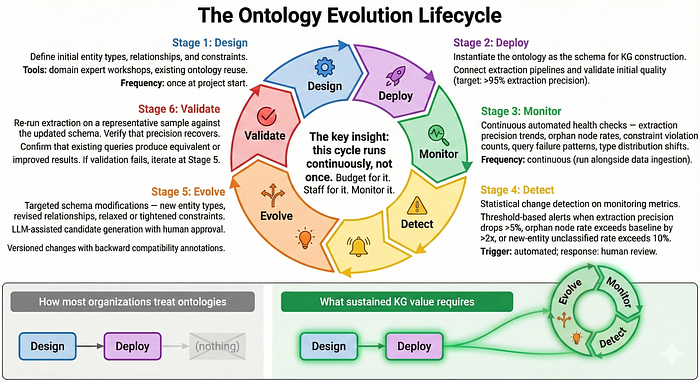
The key insight from the concept drift literature is that detection must be continuous and automated, not periodic and manual. Data pipelines run continuously. The ontology health check should too. The cost of monitoring is a fraction of the cost of rebuilding a graph whose schema has silently diverged from reality.
概念漂移文獻的關鍵洞見在於,偵測必須是持續且自動化的,而非週期性且人工的。資料流程持續不斷地執行。本體論的健康檢查也應該如此。監控的成本,只是重建一個結構描述已悄悄偏離現實的圖譜所需成本的一小部分。
From Project to Practice: Treating Ontology Evolution as a Lifecycle / 從專案到實務:將本體論演變視為一種生命週期
Detection alone is insufficient. Catching drift is pointless if the organization has no practice for responding to it. And this is where the biggest mistake lies: most organizations treat the ontology as a project deliverable rather than a living system. The ontology gets designed, reviewed, approved, and deployed — and then enters a maintenance mode that is, in practice, no maintenance at all. The LOT4KG finding — that 17 real-world projects account for data ingestion but not ontology evolution — is damning precisely because it's so universal.
單靠偵測是不夠的。如果組織沒有回應漂移的實務做法,捕捉到漂移就毫無意義。而這正是最大錯誤所在:大多數組織將本體論視為一項專案交付物,而非一個活的系統。本體論被設計、審查、批准並部署——然後進入一個維護模式,而這在實務上根本是毫無維護可言。LOT4KG 的發現——17 個真實世界專案考慮了資料攝取卻不考慮本體論演變——之所以如此該受譴責,正是因為它如此普遍。
The fix isn't a better ontology design process. It's recognizing that ontology evolution is a continuous practice, like code maintenance or data quality monitoring, not a one-time effort.
解決之道不是一個更好的本體論設計流程。而是認清本體論的演變是一種持續的實務,就像程式碼維護或資料品質監控一樣,而非一次性的投入。
Lehman's Laws of Software Evolution, formulated between 1974 and 1996, provide the theoretical foundation. Lehman demonstrated that any system operating in and modeling the real world (what he called an "E-type system") must be continually adapted, or it becomes progressively less satisfactory. Furthermore, as changes are implemented, interactions and dependencies increase — leading to growing entropy unless active work reduces it. Ontologies are E-type systems. Entropy is the default state.
萊曼的軟體演化定律 (Lehman's Laws of Software Evolution),制定於 1974 至 1996 年間,提供了理論基礎。萊曼證明,任何在真實世界中運作並對其建模的系統(他稱之為「E 型系統 (E-type system)」)都必須被持續調適,否則它會逐漸變得越來越不令人滿意。此外,隨著變更被實施,互動與相依性會增加——導致熵 (entropy) 不斷增長,除非有主動的工作來減少它。本體論就是 E 型系統。熵是其預設狀態。
What does continuous ontology evolution look like in practice?
持續的本體論演變在實務上是什麼樣子?
Version, don't replace. Maintain an explicit history of schema changes so that downstream consumers can understand when and why the ontology evolved. This is the equivalent of database migration scripts — except the knowledge graph community hasn't yet developed the discipline that the software community built around schema migrations over the past two decades.
做版本控管,而非取代。 維護一份明確的結構描述變更歷史,好讓下游消費者能理解本體論是何時以及為何演變的。這相當於資料庫遷移腳本——只不過知識圖譜社群還沒有發展出軟體社群在過去二十年間圍繞結構描述遷移所建立的那套紀律。
Budget for curation, not just construction. The ONTOCOM cost model, validated on 36 real-world ontology engineering projects, quantifies what practitioners already suspect: the ongoing cost of ontology maintenance rivals or exceeds the initial construction cost. Organizations that budget for a six-month ontology design phase and zero ongoing maintenance are setting themselves up for the silent degradation curve.
為策展編列預算,而不只是為建構。 在 36 個真實世界本體論工程專案上驗證過的 ONTOCOM 成本模型量化了從業者早已懷疑的事:本體論維護的持續成本可與初始建構成本相匹敵,甚至超過它。那些為六個月本體論設計階段和零持續維護編列預算的組織,正在為自己鋪設出那條無聲退化的曲線。
Adopt the incremental pattern. LightRAG demonstrated that incremental knowledge graph updates achieve a 50% cost reduction compared to full rebuilds while maintaining quality. The same principle applies to ontology evolution: evolve incrementally through targeted type additions, relationship modifications, and constraint adjustments, rather than periodic wholesale redesigns. Small, frequent changes are easier to test, easier to communicate to downstream consumers, and less likely to introduce cascading breakage.
採用增量模式。 LightRAG 展示了增量式知識圖譜更新在維持品質的同時,相較於完整重建能達成 50% 的成本削減。同樣的原則適用於本體論演變:透過有針對性的類型新增、關係修改和約束調整來增量地演變,而非週期性的全面重新設計。小而頻繁的變更更容易測試、更容易傳達給下游消費者,也較不可能引入連鎖式的崩壞。
Use LLMs to accelerate (but not replace) human judgment. The Artificial Intelligence Ontology (AIO) project demonstrates a pattern in which LLMs continuously suggest new terms or relations based on incoming data, while human experts approve and refine them. MILA's depth-first strategy invokes LLMs only for uncertain ontology mappings, reducing overhead while maintaining high-quality decisions on the ones that matter. This is not about automating ontology evolution — it's about making human curation fast enough to keep pace with domain change.
運用大型語言模型來加速(但不取代)人類判斷。 人工智慧本體論 (Artificial Intelligence Ontology, AIO) 專案展示了一種模式,其中大型語言模型根據流入的資料持續建議新的術語或關係,而人類專家則批准並精修它們。MILA 的深度優先策略僅在遇到不確定的本體論對應時才調用大型語言模型,在對重要的對應維持高品質決策的同時,降低了額外開銷。這並不是要將本體論演變自動化——而是要讓人類的策展快到足以跟上領域變化的步調。
Know when drift matters less. Not every domain changes at the same speed. Historical archives, mature scientific taxonomies, and static reference knowledge experience drift on the order of years, not months. The urgency of continuous evolution depends on your domain's rate of change. But if your knowledge graph operates in e-commerce, financial services, healthcare, or any domain where products, regulations, or organizational structures shift quarterly — you're in drift territory, whether you're watching for it or not.
要知道漂移何時較不重要。 並非每個領域都以相同的速度變化。歷史檔案、成熟的科學分類法,以及靜態的參考知識,其漂移是以年為單位,而非以月為單位。持續演變的急迫性取決於你領域的變化速率。但如果你的知識圖譜運作於電子商務、金融服務、醫療照護,或任何產品、法規或組織結構每季都會轉變的領域——那麼無論你是否留意,你都身處漂移地帶。
Monitor schema health the way you monitor data health. Build dashboards that track ontology fitness alongside data quality. Extraction precision trends, orphan node rates, type distribution shifts, constraint violation counts — these metrics should be as visible to operations teams as query latency and throughput. If your monitoring infrastructure can tell you when the database is slow but not when the ontology is wrong, it is incomplete.
用你監控資料健康的方式來監控結構描述健康。 建立能與資料品質並行追蹤本體論健全度的儀表板。擷取精確度趨勢、孤立節點率、類型分佈偏移、約束違反次數——這些指標對營運團隊而言,應該要和查詢延遲與吞吐量一樣清晰可見。如果你的監控基礎架構能告訴你資料庫何時變慢,卻無法告訴你本體論何時出錯,那麼它就是不完整的。
Press enter or click to view image in full size
按 Enter 或點擊以檢視完整尺寸的圖片
What Other Fields Already Know / 其他領域早已知曉的事
The knowledge graph community is not the first to grapple with the problem of classification systems that drift from reality. Other fields have been managing this for decades — in some cases, centuries — and their lessons transfer directly.
知識圖譜社群並非第一個與「分類系統偏離現實」這個問題搏鬥的群體。其他領域已經管理這件事數十年——在某些情況下甚至數個世紀——而它們的教訓可以直接轉移過來。
Biological taxonomy has been managing ontology drift since Linnaeus. The pre-Darwinian classification system organized life by superficial resemblance. Post-Darwin, the system was reorganized around evolutionary relationships — a fundamental schema migration driven by new theoretical understanding. Today, molecular phylogenetics continues to force reclassifications as DNA evidence contradicts morphological groupings. The field's lesson: classification drift is permanent and expected. The cost is managed by minimizing disruption during evolution, not by preventing change. The Natural History Museum describes modern taxonomy as "a fluid, dynamic system constantly updated by new molecular and computational findings." Replace "molecular and computational findings" with "business domain changes and new data patterns," and you have a description of what ontology management should look like.
生物分類學 (Biological taxonomy) 自林奈 (Linnaeus) 以來就一直在管理本體漂移。前達爾文 (pre-Darwinian) 的分類系統依據表面上的相似性來組織生命。後達爾文時期,這個系統圍繞演化關係被重新組織——這是一次由新的理論理解所驅動的根本性結構描述遷移。如今,分子系統發生學 (molecular phylogenetics) 隨著 DNA 證據與形態學分群相牴觸,持續迫使物種重新分類。這個領域的教訓是:分類漂移是永久性的、也是預期之中的。成本是透過在演變過程中最小化干擾來管理的,而非透過阻止變化。自然史博物館 (Natural History Museum) 將現代分類學描述為「一個流動、動態的系統,不斷被新的分子與計算發現所更新」。將「分子與計算發現」替換成「業務領域變化與新的資料模式」,你就得到了一份本體論管理應有樣貌的描述。
Database schema evolution provides a closer technical parallel. Brahmia's 2024 survey found that even mature relational database management systems provide only limited schema evolution support across six dimensions: model changes, approach changes, semantic changes, propagation, constraints, and software integration. Graph databases face the same challenges, compounded by the richer semantic structure of ontologies versus relational schemas. TigerGraph requires 15–20 minute schema reloads and query recompilation for any schema change — fine for initial development, problematic for continuous evolution in production. Neo4j's schema-optional model offers greater flexibility but shifts the burden of consistency enforcement to the application. Neither approach was designed for the kind of continuous, monitored, automated schema evolution that ontology drift demands.
資料庫結構描述演變 (Database schema evolution) 提供了一個技術上更貼近的類比。Brahmia 於 2024 年的綜述發現,即使是成熟的關聯式資料庫管理系統,在六個維度上也僅提供有限的結構描述演變支援:模型變更、方法變更、語意變更、傳播、約束和軟體整合。圖資料庫面臨相同的挑戰,並且因本體論相對於關聯式結構描述具有更豐富的語意結構而更加複雜。TigerGraph 針對任何結構描述變更都需要 15 到 20 分鐘的結構描述重新載入和查詢重新編譯——這對初始開發而言尚可,但對生產環境中的持續演變而言則有問題。Neo4j 的結構描述可選 (schema-optional) 模型提供了更大的彈性,卻將一致性強制執行的負擔轉移給了應用程式。這兩種方法都不是為本體漂移所要求的那種持續、受監控、自動化的結構描述演變而設計的。
The concept of technical debt — Ward Cunningham's 1992 metaphor — provides the framing that will resonate most with engineering leadership. Ontology debt is the accumulated cost of misalignment between schema structure and domain understanding. The "interest" on this debt is paid in extra engineering effort, broken queries, wrong answers, and — most expensively — lost trust. Like code debt, ontology debt can be managed through conscious investment or ignored until it forces a costly rewrite. Unlike code debt, ontology debt is almost never tracked, measured, or budgeted for.
技術債 (technical debt) 的概念——沃德·康寧漢 (Ward Cunningham) 於 1992 年的比喻——提供了一個最能引起工程領導層共鳴的框架。本體論債務是結構描述結構與領域理解之間錯位所累積的成本。這筆債務的「利息」是以額外的工程投入、崩壞的查詢、錯誤的答案,以及——代價最高昂的——失去的信任來償付的。就像程式碼債務一樣,本體論債務可以透過有意識的投資來管理,也可以被忽視直到它迫使一次代價高昂的重寫。但與程式碼債務不同的是,本體論債務幾乎從未被追蹤、衡量或編列預算。
Where This Leaves Us / 這將我們帶到何處
We've now argued, across three articles, for a specific architectural vision: ontologies provide the structural scaffolding that AI agents and RAG systems need (our first article argued this), knowledge graphs give that scaffolding a faithful, queryable home (our second article argued this), and — as this article has tried to show — both the ontology and the graph require continuous, monitored evolution to deliver sustained value.
我們如今已在三篇文章中論證了一個特定的架構願景:本體論提供了 AI 代理和 RAG 系統所需的結構性鷹架(我們的第一篇文章論證了這點),知識圖譜給予了這個鷹架一個忠實、可查詢的家(我們的第二篇文章論證了這點),而——正如本文試圖展示的——本體論和圖譜兩者都需要持續、受監控的演變才能帶來持久的價值。
The adoption gap isn't a technology problem. The 73% of organizations without production knowledge graphs aren't held back by database performance, extraction quality, or model capabilities. They're held back by the organizational and methodological challenge of treating ontologies as living systems rather than project deliverables. And the organizations that do reach production often see their graphs silently degrade because nobody budgeted for — or even conceptualized — the maintenance that sustained value requires.
採用率的落差不是一個技術問題。那 73% 沒有生產環境知識圖譜的組織,並非受阻於資料庫效能、擷取品質或模型能力。他們是受阻於「將本體論視為活的系統而非專案交付物」這項組織性與方法論上的挑戰。而那些確實抵達生產環境的組織,往往眼睜睜看著自己的圖譜無聲地退化,因為沒有人為持久價值所需的維護編列預算——甚至沒有人將其概念化。
Ontology drift is not a defect. It's the natural cost of operating in the real world — the cost of modeling a changing domain with a fixed schema. The defect is pretending the schema doesn't need to change.
本體漂移不是一種缺陷。它是在真實世界中運作的自然成本——是用一個固定的結構描述去對一個變化中的領域建模的成本。真正的缺陷,是假裝結構描述不需要改變。
Concept drift didn't go away when the ML community named it. But naming it made it visible, and visibility made it manageable. The organizations that take ontology drift seriously — that monitor for it, budget for it, and treat schema evolution as a continuous practice rather than a crisis response — will be the ones whose knowledge graphs still deliver value in year three and beyond.
概念漂移並沒有因為機器學習社群為它命名就消失。但命名讓它變得可見,而可見性讓它變得可管理。那些認真對待本體漂移的組織——那些為它監控、為它編列預算,並將結構描述演變視為一種持續實務而非危機應對的組織——將會是那些知識圖譜在第三年及往後仍持續帶來價值的組織。
The organizations that fail with knowledge graphs won't be the ones that built the wrong graph. They'll be the ones who built the right graph — and then forgot to evolve it.
那些在知識圖譜上失敗的組織,不會是那些建構了錯誤圖譜的組織。他們會是那些建構了正確圖譜——然後忘了讓它演變的組織。
See also dynamic ontologies and context blindness in RAG systems and why AI agents need ontology-grounded graph memory. The production failure analysis draws on Google Research's "Industry-scale Knowledge Graphs: Lessons and Challenges" (ACM Queue), Pernisch et al.'s LOT4KG methodology (ESWC 2024), and quantitative studies of Wikidata (arXiv:2511.04926), SNOMED CT (PMC6537875), and the Gene Ontology (PLOS ONE). The concept drift framework draws on Tsymbal (2004) and Ditzler et al. (2015, IEEE Computational Intelligence Magazine). The SemaDrift detection framework is from the Journal of Web Semantics (2018).
另請參閱 RAG 系統中的動態本體論與情境盲點 以及 為什麼 AI 代理需要以本體為基礎的圖記憶。生產失敗分析取材自 Google Research 的《產業規模知識圖譜:教訓與挑戰》(ACM Queue)、Pernisch 等人的 LOT4KG 方法論 (ESWC 2024),以及對 Wikidata 的量化研究 (arXiv:2511.04926)、SNOMED CT(PMC6537875)和基因本體論(PLOS ONE)。概念漂移框架取材自 Tsymbal (2004) 與 Ditzler 等人 (2015, IEEE Computational Intelligence Magazine)。 SemaDrift 偵測框架 出自《Journal of Web Semantics》(2018)。
Key references:
主要參考文獻:
- Industry-scale Knowledge Graphs: Lessons and Challenges — Google Research (ACM Queue, 2019)
- 產業規模知識圖譜:教訓與挑戰 — Google Research(ACM Queue, 2019)
- Diagnosing and Mitigating Semantic Inconsistencies in Wikidata — arXiv:2511.04926 (2025)
- 診斷與緩解 Wikidata 中的語意不一致性 — arXiv:2511.04926(2025)
- LOT4KG: When Ontologies Met Knowledge Graphs — Pernisch et al. (ESWC 2024)
- LOT4KG:當本體論遇上知識圖譜 — Pernisch 等人(ESWC 2024)
- The Problem of Concept Drift — Tsymbal (Trinity College Dublin, 2004)
- 概念漂移的問題 — Tsymbal(都柏林三一學院,2004)
- Learning in Nonstationary Environments — Ditzler et al. (IEEE CIM, 2015)
- 在非穩態環境中學習 — Ditzler 等人(IEEE CIM, 2015)
- SemaDrift: A Framework for Measuring Semantic Drift — Journal of Web Semantics (2018)
- SemaDrift:一個衡量語意漂移的框架 — Journal of Web Semantics(2018)
- Quality Assurance of UMLS Semantic Type Assignments — PMC6537875
- UMLS 語意類型指派的品質保證 — PMC6537875
- Measuring the Evolution of Ontology Complexity: The Gene Ontology — PLOS ONE
- 衡量本體論複雜度的演變:基因本體論 — PLOS ONE
- ONTOCOM: A Cost Estimation Model for Ontology Engineering — Springer (2006)
- ONTOCOM:本體論工程的成本估算模型 — Springer(2006)
- Lehman's Laws of Software Evolution — Lehman (1974–1996)
- 萊曼的軟體演化定律 — Lehman(1974–1996)
- LightRAG: Simple and Fast Retrieval-Augmented Generation — Guo et al. (EMNLP 2025)
- LightRAG:簡單且快速的檢索增強生成 — Guo 等人(EMNLP 2025)
- OG-RAG: Ontology-Grounded RAG — Microsoft Research (EMNLP 2025)
- OG-RAG:以本體為基礎的 RAG — Microsoft Research(EMNLP 2025)
- ODKE+: Schema-Guided Extraction — Apple Research (2025)
- ODKE+:結構描述引導的擷取 — Apple Research(2025)
- Building the LinkedIn Knowledge Graph — LinkedIn Engineering Blog
- 建構 LinkedIn 知識圖譜 — LinkedIn 工程部落格
- Building and Maintaining Knowledge Graphs for Pharma — OntoForce
- 為製藥業建構與維護知識圖譜 — OntoForce
- Schema Evolution in Database Systems — Brahmia (World Scientific, 2024)
- 資料庫系統中的結構描述演變 — Brahmia(World Scientific, 2024)
🔤 關鍵術語
| 英文 | 繁中譯名 | 文章中的脈絡 / 簡短說明 |
|---|---|---|
| Ontology Drift | 本體論漂移 | 文章核心概念:知識圖譜的形式化 schema 與其所代表的現實之間逐漸偏離,不會報錯卻讓查詢結果悄悄變差 |
| Knowledge Graph (KG) | 知識圖譜 | 以實體與關係建構的可查詢知識結構;文章討論其進入生產環境與維護的困境 |
| Ontology | 本體論 | 正式宣告某領域中實體類型、關係及約束的「地圖」;是漂移發生的主體 |
| Graph RAG / GraphRAG | 圖譜檢索增強生成 | 結合知識圖譜的 RAG 研究方向,近期在各大會議大量發表 |
| RAG (Retrieval-Augmented Generation) | 檢索增強生成 | 以外部知識檢索輔助 LLM 生成;漂移會使其回傳結果相關性下降 |
| Concept Drift | 概念漂移 | ML 領域中目標變數統計特性隨時間改變、導致模型退化的現象,作者借此類比本體論漂移 |
| Entity Type Drift | 實體類型漂移 | 三種漂移之一:既有類別無法乾淨切分領域(如電競 e-sports 之於「運動」類型) |
| Relationship Drift | 關係漂移 | 三種漂移之一:實體間連結改變、或新關係模式無法被 schema 表達(尤見於時序領域) |
| Constraint Drift | 約束漂移 | 三種漂移之一:本體論編碼的業務規則不再成立(如「一員工屬一部門」遇矩陣式組織) |
| Schema-Guided Extraction | schema 引導式抽取 | 提供 schema 指引時,LLM 抽取實體與關係可達 98.8% precision;Apple ODKE+ 方法 |
| Open-Domain Extraction | 開放領域抽取 | 無 schema 指引的抽取,易產生碎裂類型(如將 DEITY/GOD/GODDESS 拆為不同實體型別) |
| Entity Disambiguation | 實體消歧 | 多來源整合時,跨來源同義詞指向同一實體、同名卻屬性不同所引發的難題 |
| Metamodel Architecture / Metatypes | 元模型架構/元類型 | Google 以多層元模型讓底層固定、上層透過 metatypes 演化,藉此工程化繞過漂移 |
| Disjoint Union Statements / Disjoint Class Pairs | 不相交聯集陳述/不相交類別對 | Wikidata 有 740 條不相交聯集陳述,衍生 6,995 組被實際資料違反的不相交類別對 |
| SPARQL / Cypher | SPARQL/Cypher | 圖譜查詢語言;漂移下仍正常執行回傳 triples,故錯誤不易被察覺 |
| Vector Indexing | 向量索引 | 圖資料庫原生支援的向量索引能力,屬「建構」端已被解決的技術 |
| SemaDrift | SemaDrift(語意漂移框架) | 2018 年提出的語意變化量測框架,含 label、intension、extension 三個測量面向 |
| Orphan Node Rate | 孤立節點率 | 圖結構健康度指標之一,可作為偵測漂移的自動化健康檢查 |
| E-type System | E 型系統 | Lehman 定義中會建模真實世界、必須持續調適否則退化的系統;本體論即屬之 |
| Ontology Debt / Technical Debt | 本體論負債/技術負債 | 借 Ward Cunningham 的技術負債隱喻,指 schema 與領域理解錯位所累積、卻幾乎從不被追蹤的成本 |