RAG 系統完整指南(2026 版)
文章資訊
作者:Basukori 日期:2026-06-13
原文標題:RAG Systems: The Complete Zero-to-Hero Guide (2026 Edition)
📝 重點摘要
TL;DR
2026 年生成已非瓶頸,檢索品質才是 RAG 成敗關鍵。
核心問題
LLM 受限於知識截止日期、幻覺與看不見私有資料三大缺陷。RAG 透過查詢時檢索外部文件來「接地」答案。但 2026 年純向量檢索已不足,naive pipeline 有 40% 機率檢索失敗。
關鍵發現 / 數據
- Naive RAG pipeline 檢索失敗率達 40%,失敗時 LLM 仍自信地幻覺。
- Cross-encoder 重排序(retrieve top-50 → rerank top-5)使答案品質在 RAGAS 上提升 15–30%。
- 接地化使知識密集任務的幻覺率下降 60–80%(vs. 無增強)。
- GraphRAG 在複雜分析查詢上較原始 schema 檢索準確度提升達 5 倍。
- 真實案例:Dropbox 內部知識助手使內部資訊搜尋時間減少 40%。
方法亮點
- Hybrid Search:dense 向量 + 稀疏 BM25,以 RRF(k=60)融合排名,優於線性加權。
- Reranking:cross-encoder 二階段重排,解決上下文污染。
- Agentic RAG:多代理拆解查詢、多輪迭代檢索(ReAct 迴圈),2026 主流。
- RAFT / R3:前者微調時混入干擾文件學會抗噪;後者用 RL 端到端優化檢索。
對我的研究有用嗎?
GraphRAG 章節值得參考:以實體為節點、關係為邊建知識圖譜,強化跨文件推理(引用 Microsoft Edge et al. 2024)。對 LLM Graph 研究者,「context-graph-grounded RAG 提升 5 倍準確度」與 R3 的 RL 端到端可訓練檢索方向具啟發性。但本文僅泛談,深度不足,建議追讀文末原始論文與 QuarkAndCode 系列 GraphRAG 專文。
評語
入門掃盲佳作、廣度夠但偏行銷口吻;多數數據與部分 2026 arXiv 編號(如 2602.xxxxx)無法驗證,宜當地圖而非權威來源,不值深讀。
🌐 中英對照
Author: Basukori
Published:
Source: https://medium.com/@basukori8463/rag-systems-the-complete-zero-to-hero-guide-2025-edition-a92d0a529925
Fetched: 2026-06-13T00:18:33.127918
RAG Systems: The Complete Zero-to-Hero Guide (2026 Edition) / RAG 系統:從零到精通完整指南(2026 年版)
Press enter or click to view image in full size
按 Enter 或點擊以全尺寸檢視圖片
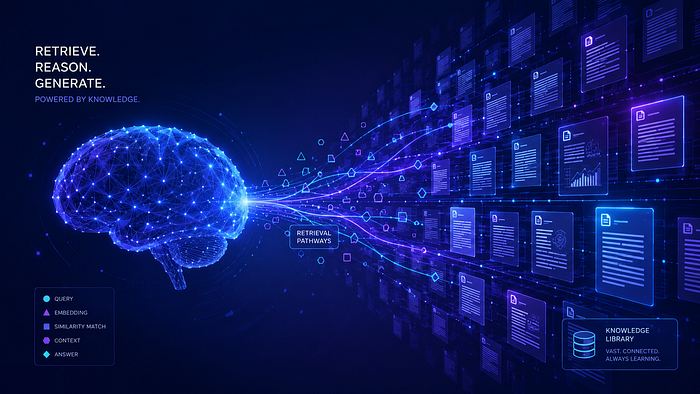
— Large Language Models are brilliant but broken by design: they hallucinate, their knowledge goes stale, and they can’t see your private data. Retrieval-Augmented Generation (RAG) fixes all three. But in 2026, vanilla RAG is table stakes — naive pipelines fail at retrieval 40% of the time. This guide takes you from “what’s a vector?” all the way to the 2026 frontier: Agentic RAG, RAFT, Hybrid Search with Reranking, access-aware pipelines, and multi-agent architectures that think, reflect, and act.
— 大型語言模型 (Large Language Models) 才華洋溢,卻有著與生俱來的缺陷:它們會產生幻覺、知識會過時,而且看不到你的私有資料。檢索增強生成 (Retrieval-Augmented Generation, RAG) 同時修復了這三個問題。但到了 2026 年,普通的 RAG 只是基本門檻——幼稚的管線在檢索階段有 40% 的時間會失敗。本指南帶你從「什麼是向量?」一路走到 2026 年的最前沿:代理式 RAG (Agentic RAG)、RAFT、結合重新排序 (Reranking) 的混合搜尋 (Hybrid Search)、權限感知 (access-aware) 管線,以及能夠思考、反思並採取行動的多代理 (multi-agent) 架構。
🎯 The Problem That Started a Revolution / 引發革命的那個問題
Picture this: you deploy a GPT-4-powered chatbot for your legal team. First week, a lawyer asks about a regulation updated three months ago. The bot confidently quotes the old rule. A client meeting later, your team discovers the mistake. The damage is done.
想像這個情境:你為法務團隊部署了一個由 GPT-4 驅動的聊天機器人。第一週,一位律師詢問三個月前更新的某項法規。機器人信心滿滿地引用了舊版規則。在一場客戶會議之後,你的團隊才發現這個錯誤。傷害已經造成。
This isn’t a hypothetical — it’s a pattern that’s played out at companies worldwide since LLMs went mainstream. And it’s not the model’s fault. It’s a fundamental limitation baked into how every large language model works.
這並非假設——自從大型語言模型成為主流以來,這種情況已在全球各地的公司一再上演。而這並不是模型的錯。這是一項根植於每個大型語言模型運作方式中的根本性限制。
The core problem: LLMs are trained on a static snapshot of the world, frozen at a cutoff date. They have no eyes, no internet connection, no access to your internal docs. When they don’t know something, they don’t say “I don’t know” — they confabulate. They hallucinate with the confidence of a tenured professor.
核心問題: 大型語言模型是在一份世界的靜態快照上訓練出來的,凍結在某個知識截止日期。它們沒有眼睛、沒有網路連線、無法存取你的內部文件。當它們不知道某件事時,它們不會說「我不知道」——而是虛構編造 (confabulate)。它們會以終身職教授般的自信產生幻覺。
RAG was born to fix this. And in 2026, it’s the backbone of virtually every serious production AI system. But here’s what’s changed: the game has shifted. Generation is no longer the bottleneck. Retrieval is. And the teams winning in AI are the ones who’ve figured that out.
RAG 的誕生正是為了解決這個問題。而到了 2026 年,它幾乎是每一個正式生產級 AI 系統的骨幹。但有件事改變了:局勢已經轉移。生成 (Generation) 不再是瓶頸。檢索 (Retrieval) 才是。 而在 AI 領域勝出的團隊,正是那些想通這一點的團隊。
🧠 What Is RAG? (The Intuition First) / 什麼是 RAG?(先從直覺說起)
Before the math, the metaphor.
在進入數學之前,先來個比喻。
Imagine you’re taking an open-book exam. You have access to a library of documents. When you get a question, you:
想像你正在參加一場開卷考試。你可以查閱一整座文件圖書館。當你拿到一道題目時,你會:
- Flip through the library to find the most relevant pages
- Read those pages to refresh your memory
-
Write your answer informed by what you just read
-
翻閱圖書館,找出最相關的頁面
- 閱讀那些頁面,喚醒你的記憶
- 撰寫你的答案,依據你剛剛讀到的內容
That’s RAG. The LLM is the student. Your document corpus is the library. The retrieval system is the index that helps you find the right pages fast.
這就是 RAG。大型語言模型就是學生。你的文件語料庫 (corpus) 就是圖書館。檢索系統則是幫你快速找到正確頁面的索引。
Press enter or click to view image in full size
按 Enter 或點擊以全尺寸檢視圖片
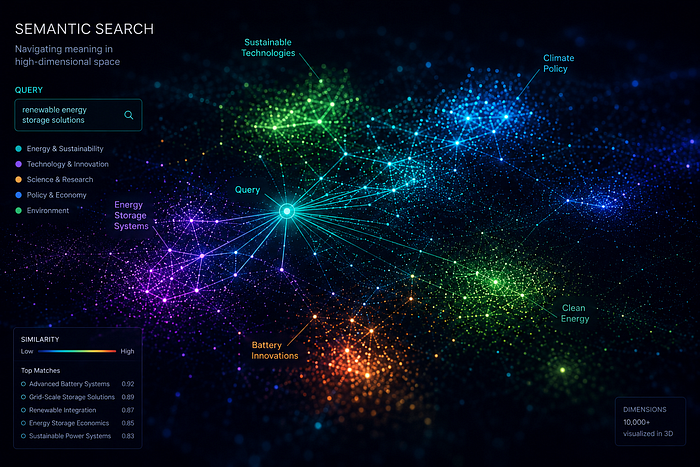
Why LLMs Alone Fail / 為何單靠大型語言模型會失敗
Problem What Happens RAG Fix Hallucination Model invents plausible-sounding facts Grounds answer in retrieved source documents Knowledge cutoff Training data has an expiry date Retrieve fresh, up-to-date documents at query time Context window limits Can’t fit your entire knowledge base in a prompt Retrieve only the relevant chunks per query Private data blindness Can’t see your internal docs, emails, code Index your private corpus, retrieve as needed
| 問題 | 會發生什麼 | RAG 的修正方式 |
|---|---|---|
| 幻覺 (Hallucination) | 模型憑空捏造聽起來合理的「事實」 | 將答案紮根於檢索到的來源文件 |
| 知識截止 (Knowledge cutoff) | 訓練資料有到期日 | 在查詢時檢索新鮮、最新的文件 |
| 上下文視窗限制 (Context window limits) | 無法把整個知識庫塞進一個提示中 | 每次查詢只檢索相關的區塊 (chunks) |
| 私有資料盲區 (Private data blindness) | 看不到你的內部文件、電子郵件、程式碼 | 為你的私有語料庫建立索引,按需檢索 |
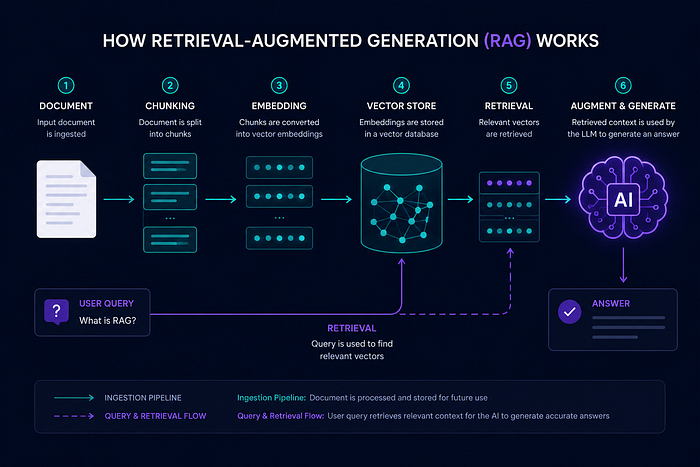
The RAG Pipeline at a Glance / RAG 管線一覽
Press enter or click to view image in full size
按 Enter 或點擊以全尺寸檢視圖片
User Query
    │
    ▼
┌──────────────────┐
│  Retriever       │  ← Hybrid search (vector + BM25) + reranking
│  (Vector DB)     │
└────────┬─────────┘
         │  Top-K relevant chunks (reranked)
         ▼
┌──────────────────┐
│  Augmenter       │  ← Inject chunks into the LLM prompt
│  (Prompt Builder)│
└────────┬─────────┘
         │  Augmented prompt
         ▼
┌──────────────────┐
│  Generator       │  ← LLM reads context, generates answer
│  (LLM)          │
└────────┬─────────┘
         │
         ▼
    Final Answer (with citations)
Three stages. Retrieve → Augment → Generate. Everything else is optimization.
三個階段。檢索 → 增強 → 生成。其餘的一切都只是最佳化。
⚙️ How It Works: The Technical Deep Dive / 運作原理:技術深度剖析
Stage 1: Document Ingestion & Chunking / 階段一:文件擷取與切塊
Before you can retrieve anything, you index your documents — PDFs, Confluence pages, Slack threads, SharePoint files, GitHub repos.
在你能檢索任何東西之前,你得先為你的文件建立索引——PDF、Confluence 頁面、Slack 討論串、SharePoint 檔案、GitHub 儲存庫。
Chunking is an art. Too small: chunks lack context. Too large: you exceed the embedding model’s token limit and dilute relevance.
切塊 (Chunking) 是一門藝術。 切得太小:區塊缺乏上下文。切得太大:你會超出嵌入模型 (embedding model) 的 token 限制,並稀釋相關性。
Common strategies in 2026:
2026 年常見的策略:
- Recursive character splitting: LangChain’s default — tries
\n\n, then\n, then. 512 tokens, 64 overlap is still a solid starting point. - Semantic chunking: Split on sentence/paragraph boundaries for better coherence.
- Parent-child chunking: Store small child chunks for retrieval, return larger parent chunks to the LLM for context. Best of both worlds.
-
Late chunking: New in 2025–26 — embed the full document first, then chunk the embeddings. Preserves long-range semantic context that fixed chunking destroys.
-
遞迴字元切割 (Recursive character splitting):LangChain 的預設方式——先嘗試
\n\n,再來\n,依此類推。512 個 token、64 個重疊 (overlap) 仍然是個穩健的起點。 - 語意切塊 (Semantic chunking):在句子/段落邊界處切割,以獲得更好的連貫性。
- 父子切塊 (Parent-child chunking):儲存較小的子區塊供檢索使用,再把較大的父區塊回傳給大型語言模型作為上下文。兼得兩者之長。
- 延遲切塊 (Late chunking):2025–26 年新出現的做法——先嵌入整份文件,再對嵌入結果進行切塊。能保留固定切塊會破壞的長距離語意上下文。
Stage 2: Embedding Models & Vector Databases / 階段二:嵌入模型與向量資料庫
Each chunk converts into a dense vector that encodes semantic meaning. In 2026, the embedding model landscape has matured significantly.
每個區塊都會轉換成一個編碼語意的密集向量 (dense vector)。到了 2026 年,嵌入模型的版圖已經顯著成熟。
Top embedding models:
頂尖的嵌入模型:
text-embedding-3-large(OpenAI) — still a strong general-purpose baselinevoyage-3.5(Voyage AI) — best-in-class for code and technical contentembed-v4.0(Cohere) — strong multilingual support, native int8 quantization-
nomic-embed-text-v2— open-source, MoE architecture, locally runnable -
text-embedding-3-large(OpenAI)——仍是一個強大的通用基準 voyage-3.5(Voyage AI)——在程式碼與技術內容方面同類最佳embed-v4.0(Cohere)——強大的多語言支援、原生 int8 量化 (quantization)nomic-embed-text-v2——開源、採用混合專家 (MoE) 架構、可在本地端執行
Vector databases in 2026:
2026 年的向量資料庫:
Database Best For Standout Feature Pinecone Production scale Serverless, native hybrid search Weaviate Hybrid search BM25 + vector fusion built-in Chroma Local dev & prototypes Zero infra, Python-native Qdrant Performance-sensitive prod Rust-based, quantization support pgvector Already on Postgres No new infra required MongoDB Atlas MERN stack teams Natural fit for document stores
| 資料庫 | 最適合的場景 | 亮點特色 |
|---|---|---|
| Pinecone | 生產級規模 | 無伺服器 (Serverless)、原生混合搜尋 |
| Weaviate | 混合搜尋 | 內建 BM25 + 向量融合 |
| Chroma | 本地開發與原型 | 零基礎設施、原生 Python |
| Qdrant | 對效能敏感的生產環境 | 以 Rust 打造、支援量化 |
| pgvector | 已在使用 Postgres | 無需新增基礎設施 |
| MongoDB Atlas | MERN 技術棧團隊 | 天生契合文件型儲存 |
Stage 3: Hybrid Search — The 2026 Standard / 階段三:混合搜尋——2026 年的標準
Pure vector search is no longer enough. In 2026, the production standard is hybrid search: combining dense vector similarity with sparse BM25 keyword matching.
純向量搜尋已經不夠用了。 到了 2026 年,生產環境的標準是混合搜尋 (hybrid search):把密集向量相似度與稀疏的 BM25 關鍵字比對結合起來。
Why? Vector search understands semantics but fails at exact matches. BM25 nails exact product names, IDs, and technical terms but misses paraphrases. Hybrid search covers both.
為什麼?向量搜尋懂得語意,但在精確比對上會失手。BM25 能精準命中產品名稱、ID 與技術術語,卻會錯過換句話說的表達。混合搜尋同時涵蓋兩者。
Reciprocal Rank Fusion (RRF) merges ranked lists without the score-incompatibility problem that breaks naively weighted averaging. RRF with k=60 consistently outperforms linear combination in benchmarks.
互逆排名融合 (Reciprocal Rank Fusion, RRF) 能合併多個排名清單,而不會遇到「分數不相容」這個會破壞幼稚加權平均的問題。在各項基準測試中,k=60 的 RRF 始終優於線性組合。
def reciprocal_rank_fusion(vector_results, bm25_results, k=60):
    scores = {}
    for rank, doc in enumerate(vector_results):
        scores[doc.id] = scores.get(doc.id, 0) + 1/(rank + k)
    for rank, doc in enumerate(bm25_results):
        scores[doc.id] = scores.get(doc.id, 0) + 1/(rank + k)
    return sorted(scores.items(), key=lambda x: x[1], reverse=True)
Stage 4: Reranking — The Critical Missing Layer / 階段四:重新排序——關鍵卻常被遺漏的一層
After hybrid retrieval, a cross-encoder reranker re-scores each retrieved chunk against the query. Unlike bi-encoders (which embed query and doc separately), cross-encoders compare them together — much more accurate, but too slow for large-scale first-pass retrieval.
在混合檢索之後,一個交叉編碼器重排器 (cross-encoder reranker) 會針對查詢,對每個檢索到的區塊重新評分。與雙編碼器 (bi-encoders)(分別嵌入查詢與文件)不同,交叉編碼器會把兩者放在一起比較——準確度高得多,但對於大規模的第一輪檢索而言太慢了。
The production pattern: retrieve top-50 with hybrid search → rerank to top-5 → pass to LLM.
生產環境的模式:用混合搜尋檢索前 50 名 → 重排到前 5 名 → 傳給大型語言模型。
This consistently improves answer quality by 15–30% on RAGAS metrics.
這在 RAGAS 指標上能持續地將答案品質提升 15–30%。
reranker = CrossEncoder("cross-encoder/ms-marco-MiniLM-L-6-v2")def rerank(query, retrieved_chunks, top_n=5):
    pairs = [(query, chunk.text) for chunk in retrieved_chunks]
    scores = reranker.predict(pairs)
    ranked = sorted(zip(retrieved_chunks, scores),
                    key=lambda x: x[1], reverse=True)
    return [chunk for chunk, _ in ranked[:top_n]]
Cohere’s rerank-v3.5 and bge-reranker-v2-m3 are strong alternatives, especially for multilingual corpora.
Cohere 的 rerank-v3.5 與 bge-reranker-v2-m3 是強而有力的替代選擇,尤其適用於多語言語料庫。
Stage 5: Prompt Augmentation & Generation / 階段五:提示增強與生成
Retrieved, reranked chunks get injected into a structured prompt:
檢索並重排後的區塊會被注入一個結構化的提示中:
from langchain_openai import ChatOpenAI
from langchain.chains import RetrievalQA
from langchain.prompts import PromptTemplate
PROMPT = PromptTemplate(
    input_variables=["context", "question"],
    template="""You are a precise assistant. Answer using ONLY the context below.
If the answer isn't present, respond: "I don't have enough information."CONTEXT:
{context}QUESTION: {question}ANSWER:"""
)llm = ChatOpenAI(model="gpt-4o", temperature=0)
qa_chain = RetrievalQA.from_chain_type(
    llm=llm,
    retriever=hybrid_retriever,  # your hybrid + rerank retriever
    chain_type_kwargs={"prompt": PROMPT},
    return_source_documents=True
)result = qa_chain.invoke({"query": "What are the refund policy terms?"})
print(result["result"])
print("Sources:", [d.metadata["source"] for d in result["source_documents"]])
🏗️ Build a Production RAG System From Scratch / 從零打造一個生產級 RAG 系統
Step 1: Install Dependencies / 步驟一:安裝相依套件
pip install langchain langchain-openai langchain-chroma \
            chromadb pypdf sentence-transformers rank-bm25
Step 2: Ingest, Chunk & Index / 步驟二:擷取、切塊與建立索引
from langchain_community.document_loaders import PyPDFDirectoryLoader
from langchain.text_splitter import RecursiveCharacterTextSplitter
from langchain_openai import OpenAIEmbeddings
from langchain_chroma import Chroma
loader = PyPDFDirectoryLoader("./docs/")
raw_docs = loader.load()splitter = RecursiveCharacterTextSplitter(
    chunk_size=512, chunk_overlap=64
)
chunks = splitter.split_documents(raw_docs)embeddings = OpenAIEmbeddings(model="text-embedding-3-large")
vectorstore = Chroma.from_documents(
    documents=chunks,
    embedding=embeddings,
    persist_directory="./chroma_db"
)
print(f"✅ Indexed {len(chunks)} chunks.")
Step 3: Hybrid Retriever with Reranking / 步驟三:結合重新排序的混合檢索器
from langchain_community.retrievers import BM25Retriever
from langchain.retrievers import EnsembleRetriever
from sentence_transformers import CrossEncoder
# Vector retriever
vector_retriever = vectorstore.as_retriever(search_kwargs={"k": 20})# BM25 sparse retriever
bm25_retriever = BM25Retriever.from_documents(chunks)
bm25_retriever.k = 20# Hybrid: RRF fusion
hybrid_retriever = EnsembleRetriever(
    retrievers=[bm25_retriever, vector_retriever],
    weights=[0.5, 0.5]
)# Reranker
reranker = CrossEncoder("cross-encoder/ms-marco-MiniLM-L-6-v2")def retrieve_and_rerank(query, top_n=5):
    candidates = hybrid_retriever.invoke(query)
    pairs = [(query, doc.page_content) for doc in candidates]
    scores = reranker.predict(pairs)
    ranked = sorted(zip(candidates, scores),
                    key=lambda x: x[1], reverse=True)
    return [doc for doc, _ in ranked[:top_n]]
Real-world example: Dropbox built an internal knowledge assistant using this exact pattern — ingesting thousands of internal wikis, returning cited answers to employee questions. They reported a 40% reduction in time spent searching for internal information.
真實案例:Dropbox 正是用這套模式打造了一個內部知識助理——擷取數千份內部 wiki,並為員工的提問回傳附帶引用來源的答案。他們回報,搜尋內部資訊所花費的時間減少了 40%。
🌟 Advanced RAG: The 2026 Frontier / 進階 RAG:2026 年的最前沿
Vanilla RAG is dead in production. Here’s what’s actually running in 2026.
普通的 RAG 在生產環境中已死。以下是 2026 年實際在運行的東西。
Agentic RAG — The Dominant 2026 Pattern / 代理式 RAG——2026 年的主流模式
The biggest shift in 2026: RAG is no longer a single retrieve-then-generate pass. It’s embedded inside multi-agent systems where specialized agents handle query decomposition, retrieval, validation, and synthesis — often in parallel.
2026 年最大的轉變:RAG 不再是單次的「先檢索後生成」流程。它被嵌入到多代理系統 (multi-agent systems) 之中,由各個專責代理分別處理查詢分解、檢索、驗證與綜合——而且往往是平行進行。
A-RAG (arXiv:2602.03442, Feb 2026) formalizes this with three principles:
A-RAG(arXiv:2602.03442,2026 年 2 月)用三項原則將此形式化:
- Autonomous Strategy: the agent dynamically chooses retrieval strategies based on task type
- Iterative Execution: multi-round retrieval, adapting based on intermediate results
-
Interleaved Tool Use: a ReAct-like action → observation → reasoning loop
-
自主策略 (Autonomous Strategy):代理根據任務類型動態選擇檢索策略
- 迭代執行 (Iterative Execution):多輪檢索,並依據中間結果加以調整
- 交錯式工具使用 (Interleaved Tool Use):類似 ReAct 的「行動 → 觀察 → 推理」循環
def should_retrieve(state):
    # Model decides: do I need more context?
    return "retrieve" if state["confidence"] < 0.8 else "generate"def retrieve_node(state):
    results = retrieve_and_rerank(state["query"])
    return {**state, "context": results, "iterations": state["iterations"]+1}def generate_node(state):
    answer = llm.invoke(build_prompt(state["context"], state["query"]))
    return {**state, "answer": answer}graph = StateGraph(AgentState)
graph.add_node("retrieve", retrieve_node)
graph.add_node("generate", generate_node)
graph.add_conditional_edges("retrieve", should_retrieve)
Azure AI Search now ships agentic retrieval natively — it uses LLMs to break down complex queries into focused subqueries, executes them in parallel, and returns structured responses optimized for chat models.
Azure AI Search 現在原生內建了代理式檢索 (agentic retrieval)——它運用大型語言模型把複雜查詢拆解成聚焦的子查詢,平行執行,並回傳針對聊天模型最佳化的結構化回應。
RAFT — Retrieval-Augmented Fine-Tuning / RAFT——檢索增強微調
The hottest 2025–26 development: RAFT (UC Berkeley). It combines the freshness of RAG with the domain depth of fine-tuning.
2025–26 年最熱門的發展:RAFT(加州大學柏克萊分校)。它把 RAG 的新鮮度與微調 (fine-tuning) 的領域深度結合起來。
The idea: fine-tune your model on examples that include both relevant and irrelevant (distractor) documents in the context. The model learns to ignore noise and extract signal — exactly the skill vanilla RAG-prompted models lack.
其核心理念:用在上下文中同時包含相關與不相關(干擾項,distractor)文件的範例來微調你的模型。模型藉此學會忽略雜訊、擷取訊號——這恰恰是僅靠 RAG 提示的模型所欠缺的能力。
RAG is an open-book exam where you can consult materials but might not know which pages matter. RAFT is studying the book and taking an open-book exam — you know the subject matter and where to find answers.
RAG 是一場開卷考試,你可以查閱資料,但可能不知道哪幾頁才重要。RAFT 則是既研讀過這本書,又參加開卷考試——你既懂這個主題,又知道去哪裡找答案。
This dramatically reduces hallucination in noisy retrieval environments, which is every enterprise environment.
這能在充滿雜訊的檢索環境中大幅減少幻覺——而每一個企業環境都是這樣的環境。
GraphRAG — Now Production-Ready / GraphRAG——如今已可投入生產
Microsoft’s GraphRAG (released 2024, widely adopted in 2026) indexes documents as a knowledge graph: entities are nodes, relationships are edges. This makes cross-document reasoning dramatically better.
微軟的 GraphRAG(2024 年發布,2026 年廣泛採用)把文件建索引成一個知識圖譜 (knowledge graph):實體 (entities) 是節點,關係 (relationships) 是邊。這讓跨文件推理的效果大幅提升。
pip install graphrag
graphrag init --root ./my_project
graphrag index --root ./my_project
graphrag query --root ./my_project --method global \
  "What are the relationships between our key clients and regulatory changes?"
Context-graph-grounded RAG achieves up to 5x improvements in AI analyst response accuracy over raw schema retrieval on complex analytical queries.
在複雜的分析型查詢上,以情境圖譜 (context-graph) 為基礎的 RAG,相較於原始綱要 (schema) 檢索,能讓 AI 分析師的回應準確度提升達 5 倍。
Access-Aware RAG — The Enterprise Prerequisite / 權限感知 RAG——企業的先決條件
One of the biggest 2026 trends that doesn’t get enough coverage: governance and access control in RAG pipelines.
2026 年最大、卻未獲足夠關注的趨勢之一:RAG 管線中的治理與存取控制 (access control)。
Enterprise data isn’t public. A RAG system that ignores access controls is a liability, not an asset. April 2026 tooling now allows retrieval pipelines to respect the same permissions that govern underlying data sources — so a query from a junior analyst doesn’t surface documents that should only be visible to the finance team.
企業資料不是公開的。一個忽視存取控制的 RAG 系統是負債,而非資產。2026 年 4 月的工具現在已能讓檢索管線遵循管理底層資料來源的同一套權限——因此一位初階分析師的查詢,不會浮現出本應只有財務團隊才能看到的文件。
This is now a prerequisite for enterprise adoption, and the ecosystem is finally treating it that way.
這如今已是企業導入的先決條件,而整個生態系終於開始如此看待它。
Hybrid Retrieval + Neural Reranking at Scale / 大規模的混合檢索 + 神經重排序
The 2026 production stack for serious RAG:
2026 年認真做 RAG 的生產技術棧:
Query → Metadata filter (narrow the space)
      → Parallel hybrid search (BM25 + dense ANN, top-50–500 each)
      → RRF fusion
      → Cross-encoder reranker (top-5 to top-10)
      → LLM generation with citations
The pattern “retrieve top-1000 → rerank top-100” is within p99 latency budgets for interactive search. Applying a reranker to millions of documents at query time is architecturally incorrect — first-stage ANN retrieval exists precisely to make reranking tractable.
「檢索前 1000 名 → 重排前 100 名」這種模式,在互動式搜尋的 p99 延遲預算範圍內。在查詢時對數百萬份文件套用重排器,在架構上是錯誤的——第一階段的近似最近鄰 (ANN) 檢索之所以存在,正是為了讓重排變得可行。
RL-Optimized Retrieval (R3) / 以強化學習最佳化的檢索(R3)
R3 (HKUST, 2025) introduces retrieval optimization via reinforcement learning. Instead of static relevance labels, the retriever learns from RAG task outcomes — the first retriever that optimizes for what actually makes the downstream generation better, not just what’s superficially similar to the query. A significant step toward end-to-end trainable RAG.
R3(香港科技大學,2025)引入了透過強化學習 (reinforcement learning) 進行檢索最佳化的方法。檢索器不再依賴靜態的相關性標籤,而是從 RAG 任務的成果中學習——這是第一個針對「真正能讓下游生成變得更好」而非「只是表面上與查詢相似」進行最佳化的檢索器。這是邁向端到端可訓練 RAG 的重要一步。
Multimodal RAG — Images, Tables, Video / 多模態 RAG——影像、表格、影片
2026 multimodal RAG goes beyond text and images into audio, video, and tabular data:
2026 年的多模態 (Multimodal) RAG 已超越文字與影像,延伸到音訊、影片與表格資料:
- ColPali / VimRAG: embed document page images directly, no OCR required. VimRAG (arXiv:2602.12735) introduces a multimodal memory graph for navigating massive visual corpora.
- Tabular RAG: structured data (SQL, CSV) retrieved alongside unstructured docs and fused at the generation stage.
-
Video RAG: frame-level and transcript-level embeddings for video corpora.
-
ColPali / VimRAG:直接嵌入文件頁面的影像,無需 OCR。VimRAG(arXiv:2602.12735)引入了一個多模態記憶圖譜 (multimodal memory graph),用以在龐大的視覺語料庫中導覽。
- 表格 RAG (Tabular RAG):結構化資料(SQL、CSV)與非結構化文件一同被檢索,並在生成階段加以融合。
- 影片 RAG (Video RAG):為影片語料庫建立影格層級 (frame-level) 與逐字稿層級 (transcript-level) 的嵌入。
Real-world example: A maintenance engineer can ask “Show me the failure pattern for turbine blade anomalies over the past year and explain it” — and the system retrieves diagnostic charts, maintenance logs, and audio inspection notes together.
真實案例:一位維修工程師可以問「給我看過去一年渦輪葉片異常的故障模式,並加以解釋」——系統便會一併檢索診斷圖表、維修日誌與語音檢測筆記。
RAG as a Service & LLMOps Integration / RAG 即服務與 LLMOps 整合
By 2026, RAG frameworks are integrating natively with LLMOps platforms. Enterprises now monitor retrieval quality, contextual relevance, latency, and cost alongside model performance — all in the same observability dashboard. Continuous quality maintenance at scale is becoming the norm, not the exception.
到了 2026 年,RAG 框架已與 LLMOps 平台原生整合。企業現在會在同一個可觀測性 (observability) 儀表板中,同時監控檢索品質、情境相關性、延遲與成本,連同模型效能一併追蹤。大規模的持續品質維護正逐漸成為常態,而非例外。
✅ Advantages of RAG / RAG 的優點
Factual grounding with citations — Every answer traces to a source document. Transformative for regulated industries.
附帶引用的事實紮根 — 每個答案都能追溯到一份來源文件。對受監管的產業而言具有變革性意義。
No retraining required — Update your knowledge base by adding documents. No GPU cycles, no fine-tuning pipeline.
無需重新訓練 — 只要新增文件就能更新你的知識庫。不需要 GPU 運算週期,也不需要微調管線。
Privacy-preserving — With a self-hosted vector DB and local LLM, your data never leaves your infrastructure.
保護隱私 — 搭配自架的向量資料庫與本地大型語言模型,你的資料永遠不會離開你的基礎設施。
Dramatically reduced hallucination — Grounding drops hallucination rates by 60–80% vs. unaugmented prompting on knowledge-intensive tasks (RAGAS benchmarks).
大幅減少幻覺 — 在知識密集型任務上,相較於未經增強的提示,紮根能將幻覺率降低 60–80%(RAGAS 基準測試)。
Real-world example: Notion AI uses RAG to let users chat with their own pages. The LLM never sees the entire workspace — only chunks most relevant to each question.
真實案例:Notion AI 運用 RAG 讓使用者能與自己的頁面對話。大型語言模型永遠看不到整個工作區——只看得到與每個問題最相關的區塊。
❌ Disadvantages & Limitations (Be Honest) / 缺點與限制(誠實面對)
Retrieval failures cascade — Naive pipelines fail at retrieval 40% of the time. If the retriever surfaces irrelevant chunks, the LLM hallucinates anyway — with false confidence, because it thinks it’s grounded.
檢索失敗會連鎖蔓延 — 幼稚的管線在檢索階段有 40% 的時間會失敗。如果檢索器浮現的是不相關的區塊,大型語言模型照樣會產生幻覺——而且帶著虛假的自信,因為它以為自己有所依據。
Semantic gap is real — “How do I cancel my subscription?” might not semantically match “Account Termination Policy.” Hybrid search helps; it doesn’t eliminate this.
語意鴻溝真實存在 — 「我要怎麼取消訂閱?」在語意上可能無法對應到「帳戶終止政策」。混合搜尋有幫助,但無法消除這個問題。
Context window pollution — Retrieving 10 chunks when only 2 are relevant dilutes the signal. The LLM averages across all context, producing mediocre answers. Reranking addresses this.
上下文視窗污染 — 在只有 2 個區塊相關時卻檢索了 10 個,會稀釋訊號。大型語言模型會在所有上下文之間取平均,產生平庸的答案。重排能解決這個問題。
Embedding model lock-in — Switch embedding models? Re-embed your entire corpus. Old and new embeddings are incompatible vector spaces.
嵌入模型的鎖定效應 — 想換嵌入模型?那就得把整個語料庫重新嵌入一遍。新舊嵌入是不相容的向量空間。
Governance complexity — Access-aware RAG pipelines are non-trivial. Getting permissions, metadata, and data sensitivity right is a prerequisite for enterprise deployment.
治理的複雜性 — 權限感知的 RAG 管線並不簡單。把權限、中介資料 (metadata) 與資料敏感度處理妥當,是企業部署的先決條件。
Evaluation is hard and underestimated — You need custom evaluation pipelines (RAGAS, TruLens, or custom evals with LLM-as-judge). This is consistently the most underestimated part of a RAG project.
評估既困難又被低估 — 你需要客製化的評估管線(RAGAS、TruLens,或以「大型語言模型當裁判」(LLM-as-judge) 的自訂評估)。這始終是 RAG 專案中最被低估的環節。
🌍 Where RAG Is Used Today / 如今 RAG 用在哪些地方
Healthcare: Epic Systems uses RAG to surface relevant clinical guidelines and drug interaction data when physicians query patient records.
醫療保健:Epic Systems 運用 RAG,在醫師查詢病歷時浮現相關的臨床指引與藥物交互作用資料。
Legal: Harvey AI (used by Allen & Overy and other top firms) uses RAG to retrieve relevant case law and contract clauses before drafting or analyzing documents.
法律:Harvey AI(為 Allen & Overy 及其他頂尖事務所所採用)運用 RAG,在起草或分析文件之前檢索相關判例法與合約條款。
Finance: Morgan Stanley’s internal AI, built on OpenAI’s API with RAG over 100,000+ research documents, lets advisors query years of proprietary analysis instantly.
金融:摩根士丹利的內部 AI 建立在 OpenAI 的 API 之上,對超過 10 萬份研究文件進行 RAG,讓顧問能即時查詢多年來的專有分析。
Customer Support: Intercom’s Fin AI resolves tickets by retrieving from help center articles — reducing escalation to human agents by 30–40%.
客戶支援:Intercom 的 Fin AI 透過從說明中心文章中檢索來解決工單——將轉接給真人客服的比率降低了 30–40%。
Code Assistants: GitHub Copilot uses RAG to retrieve relevant code from your repository before suggesting completions.
程式碼助理:GitHub Copilot 運用 RAG,在提出補全建議之前從你的儲存庫中檢索相關程式碼。
Enterprise Search: ServiceNow, Salesforce, Atlassian, and Google Workspace have all integrated RAG deeply into their search and assistant features. Google’s Agent Development Kit, Agent Studio, and Agent Engine all support RAG-native architectures.
企業搜尋:ServiceNow、Salesforce、Atlassian 與 Google Workspace 都已把 RAG 深度整合進它們的搜尋與助理功能。Google 的 Agent Development Kit、Agent Studio 與 Agent Engine 全都支援以 RAG 為原生核心的架構。
📊 RAG vs. Fine-Tuning vs. RAFT vs. Prompt Engineering / RAG vs. 微調 vs. RAFT vs. 提示工程
Press enter or click to view image in full size
按 Enter 或點擊以全尺寸檢視圖片

The 2026 honest answer: most mature production systems use all four. RAG for knowledge grounding, fine-tuning or RAFT for behavioral conditioning, prompt engineering to tie it together.
2026 年的誠實答案:大多數成熟的生產系統四者並用。RAG 負責知識紮根,微調或 RAFT 負責行為調教,提示工程 (prompt engineering) 則把這一切串起來。
🔮 The Future of RAG / RAG 的未來
End-to-end trainable RAG — RL-optimized retrievers like R3 point toward systems where retrieval and generation are jointly optimized, not independently designed. Expect this to go mainstream by 2027.
端到端可訓練的 RAG — 像 R3 這樣以強化學習最佳化的檢索器,指向了一種「檢索與生成共同最佳化、而非各自獨立設計」的系統。預期這將在 2027 年前成為主流。
On-device RAG — Smaller, quantized embedding models (sub-1B parameters) running locally on mobile and edge devices. Your phone’s assistant retrieves from your personal document store, locally, with no cloud dependency.
裝置端 RAG — 更小、經量化的嵌入模型(參數量小於 10 億)在行動裝置與邊緣裝置上本地執行。你手機上的助理會在本地端從你的個人文件庫中檢索,完全不依賴雲端。
RAG as long-term memory — Episodic memory for AI agents stored as RAG indices. Your assistant remembers what you told it six months ago by retrieving from its memory store — with access controls so it only retrieves memories relevant to the current context.
RAG 作為長期記憶 — 將 AI 代理的情節記憶 (episodic memory) 儲存為 RAG 索引。你的助理能透過從其記憶庫中檢索,記得你六個月前告訴它的事——並搭配存取控制,使它只檢索與當前情境相關的記憶。
Continuous ingestion pipelines — Move from batch indexing to streaming ingestion. Documents are indexed within seconds of creation, making RAG knowledge bases effectively real-time.
持續擷取管線 — 從批次建索引轉向串流式擷取。文件在建立後的數秒內即被建立索引,使 RAG 知識庫實質上達到即時。
Governance-first RAG — As regulatory pressure on AI systems increases (EU AI Act, US executive orders), access-aware, auditable, explainable RAG becomes the compliance layer for enterprise AI. Retrieval logs become audit trails.
治理優先的 RAG — 隨著對 AI 系統的監管壓力升高(歐盟 AI 法案、美國行政命令),權限感知、可稽核、可解釋的 RAG 成為企業 AI 的合規層。檢索日誌將成為稽核軌跡。
🎬 Conclusion / 結論
RAG is not a trend. It’s infrastructure — and in 2026, it’s maturing fast.
RAG 不是一時的潮流。它是基礎設施——而到了 2026 年,它正在快速成熟。
The gap between “impressive demo” and “production system your team relies on” is largely filled by retrieval quality. The teams shipping reliable AI in 2026 have internalized this: generation is solved, retrieval is the engineering problem.
「令人驚豔的展示」與「你的團隊賴以運作的生產系統」之間的落差,主要靠檢索品質來填補。2026 年那些交付出可靠 AI 的團隊已將這點內化於心:生成已是已解決的問題,檢索才是工程上的難題。
Your 2026 RAG checklist:
你的 2026 年 RAG 檢查清單:
- ✅ Hybrid search (BM25 + vector), not just vector
- ✅ Reranking (cross-encoder, top-50 → top-5)
- ✅ Access-aware pipelines (permissions matter)
- ✅ Evaluation with RAGAS (measure everything)
- ✅ Agentic patterns for multi-step queries
- ✅ RAFT if you have domain-specific noisy retrieval
-
✅ GraphRAG for cross-document analytical queries
-
✅ 混合搜尋(BM25 + 向量),而不只是向量
- ✅ 重新排序(交叉編碼器,前 50 名 → 前 5 名)
- ✅ 權限感知管線(權限很重要)
- ✅ 用 RAGAS 進行評估(量測一切)
- ✅ 針對多步驟查詢的代理式模式
- ✅ 若你面對的是特定領域且充滿雜訊的檢索,就用 RAFT
- ✅ 針對跨文件的分析型查詢,使用 GraphRAG
Start simple. Measure everything. Iterate ruthlessly.
從簡單開始。量測一切。無情地迭代。
Found this useful? Share it with an engineer about to reinvent the wheel. Building something interesting with RAG in 2026? I’d love to hear about it in the comments.
覺得這篇有用嗎?把它分享給某位正打算重新造輪子的工程師吧。在 2026 年用 RAG 打造有趣的東西嗎?我很樂意在留言區聽你聊聊。
Key Papers & Resources:
重要論文與資源:
- “Retrieval-Augmented Generation for Knowledge-Intensive NLP Tasks” — Lewis et al. (2020) — the original
- “RAFT: Adapting Language Model to Domain Specific RAG” — Zhang et al., UC Berkeley (2024)
- “A-RAG: Scaling Agentic RAG via Hierarchical Retrieval Interfaces” — Du et al. (arXiv:2602.03442, 2026)
- “VimRAG: Navigating Massive Visual Context via Multimodal Memory Graph” — (arXiv:2602.12735, 2026)
- “R3: Optimizing Retrieval for RAG via Reinforcement Learning” — Zhou & Chen, HKUST (2025)
- “From Local to Global: A Graph RAG Approach” — Edge et al., Microsoft (2024)
- RAGAS evaluation framework:
github.com/explodinggradients/ragas - LangChain docs:
python.langchain.com - LlamaIndex docs:
docs.llamaindex.ai -
Microsoft GraphRAG:
github.com/microsoft/graphrag -
〈Retrieval-Augmented Generation for Knowledge-Intensive NLP Tasks〉 — Lewis 等人(2020)——開山之作
- 〈RAFT: Adapting Language Model to Domain Specific RAG〉 — Zhang 等人,加州大學柏克萊分校(2024)
- 〈A-RAG: Scaling Agentic RAG via Hierarchical Retrieval Interfaces〉 — Du 等人(arXiv:2602.03442,2026)
- 〈VimRAG: Navigating Massive Visual Context via Multimodal Memory Graph〉 —(arXiv:2602.12735,2026)
- 〈R3: Optimizing Retrieval for RAG via Reinforcement Learning〉 — Zhou 與 Chen,香港科技大學(2025)
- 〈From Local to Global: A Graph RAG Approach〉 — Edge 等人,微軟(2024)
- RAGAS 評估框架:
github.com/explodinggradients/ragas - LangChain 文件:
python.langchain.com - LlamaIndex 文件:
docs.llamaindex.ai - Microsoft GraphRAG:
github.com/microsoft/graphrag
🔤 關鍵術語
| 英文 | 繁中譯名 | 文章中的脈絡 / 簡短說明 |
|---|---|---|
| Retrieval-Augmented Generation (RAG) | 檢索增強生成 | 透過檢索外部文件來補足 LLM,解決幻覺、知識過時、無法存取私有資料三大問題 |
| Agentic RAG | 代理式 RAG | 2026 主流模式,將檢索嵌入多代理系統,由專責代理處理查詢分解、檢索、驗證與合成 |
| RAFT (Retrieval-Augmented Fine-Tuning) | 檢索增強微調 | UC Berkeley 提出,微調時在脈絡中混入相關與干擾文件,讓模型學會濾除雜訊 |
| GraphRAG | 圖譜檢索增強生成 | Microsoft 推出,將文件索引為知識圖譜(實體為節點、關係為邊),強化跨文件推理 |
| Hybrid Search | 混合檢索 | 結合稠密向量相似度與稀疏 BM25 關鍵字比對,2026 生產環境標準 |
| BM25 | BM25(稀疏關鍵字檢索) | 稀疏關鍵字匹配演算法,擅長精確比對產品名、ID、術語,與向量檢索互補 |
| Reciprocal Rank Fusion (RRF) | 倒數排名融合 | 合併多個排序清單而不受分數不相容影響,k=60 時表現穩定優於線性加權 |
| Cross-Encoder Reranker | 交叉編碼器重排器 | 將查詢與文件一起輸入比對,比雙編碼器更準,用於第一階段檢索後重排 top-5 |
| Bi-encoder | 雙編碼器 | 分別嵌入查詢與文件,速度快但精度較低,適合大規模第一階段檢索 |
| Vector Embeddings / Dense Vector | 向量嵌入/稠密向量 | 將文字片段轉為編碼語意的稠密向量,供向量資料庫檢索 |
| Vector Database | 向量資料庫 | 儲存與檢索嵌入向量,如 Pinecone、Weaviate、Chroma、Qdrant、pgvector |
| Chunking | 切塊 | 將文件切分為片段;策略含遞迴字元切分、語意切塊、父子切塊、晚期切塊 |
| Late Chunking | 晚期切塊 | 2025–26 新法,先嵌入整份文件再切塊,保留固定切塊會破壞的長距語意脈絡 |
| Knowledge Graph | 知識圖譜 | 以實體為節點、關係為邊表示文件,支援可解釋與跨文件分析查詢 |
| Approximate Nearest Neighbor (ANN) | 近似最近鄰 | 第一階段稠密檢索技術,使大規模重排在運算上可行 |
| ReAct loop | ReAct 迴圈 | 行動→觀察→推理的交錯工具使用循環,為代理式檢索的迭代基礎 |
| RAGAS | RAGAS(RAG 評估框架) | 用於量測檢索品質與答案品質的評估指標/框架 |
| LLM-as-judge | 以 LLM 為評審 | 自訂評估管線中用 LLM 來評斷答案品質的方法 |
| Multimodal RAG | 多模態 RAG | 跨文字、圖像、表格、音訊、影片檢索,如 ColPali、VimRAG、Tabular/Video RAG |
| Quantization | 量化 | 壓縮嵌入模型(如 int8、sub-1B 參數)以利效能或裝置端本地運行 |