HyperbolicRAG:彎曲空間,更好的答案
文章資訊
作者:Florian June 日期:2026-06-13
原文標題:HyperbolicRAG: Curved Spaces, Better Answers
Medium 原連結:https://levelup.gitconnected.com/hyperbolicrag-curved-spaces-better-answers-aad2736adb9c
📝 重點摘要
TL;DR
用雙曲幾何編碼知識階層,提升 GraphRAG 多跳推理的精準度。
核心問題
現有 GraphRAG(如 HippoRAG、LightRAG)把節點嵌入歐式空間,只能表達「相似度」卻無法表達「抽象層級深度」。高維歐式空間存在 hubness 問題——「健康」「疾病」等籠統概念與一切都接近,導致檢索與圖傳播漂向泛化子圖,答案正確卻空泛,遺漏真正的因果機制路徑。
關鍵發現 / 數據
- HyperbolicRAG:51.4% EM / 63.3% F1,略勝最強基線 HippoRAG2(51.0% / 62.7%)。
- 優勢集中在多跳資料集:MuSiQue 上 EM +2.3(39.5% vs 37.2%),2Wiki 亦有提升。
- 階層深度以「半徑」編碼:抽象節點靠近中心,具體事實靠近 Poincaré 球邊界。
- 對單跳或一般檢索任務,幾何複雜度提升有限,屬於 overkill。
方法亮點
- 階層感知嵌入:用 type-specific 預測器估出 0–1 深度分數,融合語意向量(concat + gating)後縮放向量範數,再映射進 Poincaré 球得到雙曲向量 zᴴ。
- 無監督雙向對齊:以 margin-based 對比損失,使段落與其抽取事實在雙曲空間互相靠近,反映文本包含結構。
- 雙空間檢索:歐式與雙曲分支各跑一次 Personalized PageRank(PPR),分別得 Rᴱ、Rᴴ。
- 互排融合:轉成 reciprocal rank 分數,雙榜共現給 consistency bonus,
s_hyb = (s_E + s_H)(1+b)。
對我的研究有用嗎?
非常值得參考。雙曲幾何用半徑天然編碼「general→specific」階層,正面對治 GraphRAG 的 hubness 與語意扁平化問題,這個幾何視角對 LLM Graph 表示學習很有啟發。「深度分數調節範數」與「雙空間 PPR + reciprocal rank 融合」是可直接借鑑的工程設計,特別適用於醫療、法律、科學等深層階層知識庫的多跳推理。
評語
觀念新穎、技術紮實,值得深讀;但 benchmark 增益偏小(平均僅勝 HippoRAG2 約 0.4–0.6 點),雙空間架構複雜度是否划算需自行斟酌,效益主要集中在多跳場景。
🌐 中英對照
Author: Florian June
作者:Florian JunePublished:
發布日期:Source: https://levelup.gitconnected.com/hyperbolicrag-curved-spaces-better-answers-aad2736adb9c
來源:https://levelup.gitconnected.com/hyperbolicrag-curved-spaces-better-answers-aad2736adb9cFetched: 2026-06-13T00:35:03.689254
擷取時間:2026-06-13T00:35:03.689254
HyperbolicRAG: Curved Spaces, Better Answers / HyperbolicRAG:彎曲空間,更好的答案
Traditional RAG systems are pretty familiar by now: retrieve a few relevant passages using dense retrieval, then feed them to a language model for answering the question.
傳統的 RAG(檢索增強生成,Retrieval-Augmented Generation)系統至今已相當為人熟悉:使用稠密檢索 (dense retrieval) 取得幾段相關的文字段落,再將它們輸入語言模型來回答問題。
GraphRAG builds on this idea by turning documents into graphs, linking entities and passages, then using multi-hop propagation to improve reasoning. It feels more structured.
GraphRAG 在這個概念之上進一步發展,將文件轉換為圖 (graph),連結實體 (entity) 與段落,接著利用多跳傳播 (multi-hop propagation) 來改善推理。它讓人感覺更具結構性。
But here is a deeper problem: while the knowledge in these graphs is hierarchical, the embedding space they live in is flat…
但這裡有一個更深層的問題:雖然這些圖中的知識是階層式 (hierarchical) 的,但它們所處的嵌入空間 (embedding space) 卻是平坦的……
Why Euclidean GraphRAG Isn't Enough / 為什麼歐幾里得 GraphRAG 還不夠
Nearly all current graph-based RAG methods:
幾乎所有目前的基於圖的 RAG 方法(graph-based RAG methods):
- G-Retriever
-
G-Retriever
-
GraphRAG (A Comprehensive Guide to Graph RAG)
-
GraphRAG(圖 RAG 完整指南)
-
HippoRAG (HippoRAG: Hippocampal Memory of RAG)
-
HippoRAG(HippoRAG:RAG 的海馬迴記憶)
-
LightRAG (AI Innovations and Trends 03: LightRAG, Docling, DRIFT, and More)
-
LightRAG(AI 創新與趨勢 03:LightRAG、Docling、DRIFT 等)
-
HippoRAG2 (AI Innovations and Insights 31: olmOCR , HippoRAG 2, and RAG Web UI)
- HippoRAG2(AI 創新與洞見 31:olmOCR、HippoRAG 2 與 RAG Web UI)
embed nodes in Euclidean space. That works well for capturing "how similar things are," but this kind of space lacks a geometric notion of hierarchical depth. It can tell you that "chronic stress" and "acute stress" are similar, but it tends not to express that "stress" is a more abstract category that includes both.
都在歐幾里得空間 (Euclidean space) 中嵌入節點。這對於捕捉「事物之間有多相似」很有效,但這種空間缺乏關於階層深度的幾何概念(geometric notion)。它可以告訴你「慢性壓力 (chronic stress)」與「急性壓力 (acute stress)」很相似,但它往往無法表達出「壓力 (stress)」是一個更抽象、同時涵蓋這兩者的範疇。
This leads to some real issues.
這會導致一些實際的問題。
Press enter or click to view image in full size
按下 enter 鍵或點擊以檢視完整大小的圖片

Figure 1: Comparison of Euclidean and hyperbolic embedding effects on retrieval-augmented multi-hop reasoning. (a) In Euclidean space, embeddings reflect surface-level similarity. General concepts (e.g., stress) act as semantic hubs, making top-k retrieval and graph propagation drift toward broad, generic subgraphs. (b) In hyperbolic space, hierarchical depth is radially encoded: abstract nodes lie near the center, while specific facts align near the boundary. Queries are thus aligned to relevant mechanism nodes (e.g., chronic stress, cortisol release), yielding more precise and causally focused reasoning. [Source].
圖 1:歐幾里得嵌入與雙曲嵌入 (hyperbolic embedding) 對檢索增強多跳推理之效果比較。(a) 在歐幾里得空間中,嵌入反映的是表面層級的相似性。一般性概念(例如壓力)扮演語意樞紐 (semantic hub) 的角色,使得 top-k 檢索與圖傳播偏移至廣泛、籠統的子圖。(b) 在雙曲空間中,階層深度以放射狀方式編碼:抽象節點位於中心附近,而具體事實則對齊於邊界附近。因此查詢得以對齊至相關的機制節點(例如慢性壓力、皮質醇釋放 (cortisol release)),產生更精確且聚焦於因果關係的推理。[來源]。
Imagine you're asking a question like: How does long-term tension (chronic stress) lead to weakened immunity?
想像你提出這樣一個問題:長期的緊張(慢性壓力)如何導致免疫力下降?
A Euclidean-based retriever is likely to pull in general terms like "health" or "illness", broad concepts that appear in many contexts, because in high-dimensional Euclidean space, these hubs are close to everything. This is a well-known problem called hubness.
基於歐幾里得空間的檢索器很可能會拉進「健康」或「疾病」這類一般性詞彙,這些是在許多脈絡中都會出現的廣泛概念,因為在高維歐幾里得空間中,這些樞紐與所有東西都很接近。這是一個眾所周知的問題,稱為樞紐性(hubness)。
So when the model tries to reason over the graph, it ends up wandering through these generic nodes. The answer you get might sound like, "Prolonged stress affects health, and poor health makes you more susceptible to illness." Technically correct, but vague. It misses the underlying biological pathway: chronic stress → cortisol release → reduced lymphocyte activity → immune suppression.
因此當模型試圖在圖上進行推理時,它最終會在這些籠統的節點間遊蕩。你得到的答案聽起來可能像:「長期的壓力會影響健康,而健康不佳會讓你更容易生病。」技術上正確,但很模糊。它遺漏了底層的生物學途徑:慢性壓力 → 皮質醇釋放 → 淋巴球 (lymphocyte) 活性降低 → 免疫抑制。
This illustrates the key limitation of using Euclidean embeddings alone in GraphRAG-style retrieval.
這說明了在 GraphRAG 式檢索中僅使用歐幾里得嵌入的關鍵限制。
The graph might encode these relationships, but the geometry of Euclidean space flattens everything into the same plane. There's no explicit geometric signal to say that some nodes represent abstract ideas while others are specific mechanisms.
圖也許編碼了這些關係,但歐幾里得空間的幾何特性把一切都壓平到同一個平面上。沒有明確的幾何訊號來表明某些節點代表抽象概念,而另一些則是具體的機制。
But real-world knowledge isn't flat. It's tree-shaped, often more like a forest: general categories branch into subcategories, which branch into individual facts. Human cognition also tends to organize concepts in terms of "general to specific." Euclidean space struggle to represent this structure cleanly. It squeezes everything into a uniform space, losing the depth.
但現實世界的知識並不是平坦的。它是樹狀的,往往更像一座森林:一般性的範疇分支成子範疇,再分支成個別的事實。人類的認知也傾向以「從一般到具體」的方式組織概念。歐幾里得空間難以乾淨地表示這種結構。它把一切都擠進一個均勻的空間,失去了深度。
HyperbolicRAG: Building Hierarchy-Aware RAG with Hyperbolic Geometry / HyperbolicRAG:以雙曲幾何建構具階層感知的 RAG
HyperbolicRAG addresses this by introducing a hyperbolic representation space alongside the standard Euclidean one, leveraging a geometry that naturally supports hierarchical structure.
HyperbolicRAG 透過在標準的歐幾里得空間之外引入一個雙曲表示空間(hyperbolic representation space)來解決這個問題,利用一種天生就支援階層結構的幾何。
General concepts sit near the center, and more specific details radiate outward. In this setup, a query about stress and immunity doesn't just retrieve nearby generic terms. It activates specific, relevant concepts that follow a logical, causal path through the graph.
一般性概念位於中心附近,而較具體的細節則向外放射。在這種設定下,關於壓力與免疫力的查詢不只是檢索鄰近的籠統詞彙,而是會啟動具體且相關的概念,沿著圖中合乎邏輯的因果路徑前進。
1. Learning to Embed with Hierarchy in Mind / 1. 在嵌入時將階層納入考量
Before hierarchy enhancement and dual-space retrieval, HyperbolicRAG first builds a heterogeneous passage–entity knowledge graph using LLM-extracted facts and entities, with entity–entity and synonymy edges providing the structural backbone for PPR.
在進行階層增強與雙空間檢索之前,HyperbolicRAG 首先利用 LLM 抽取的事實與實體,建構一個異質的段落—實體知識圖譜 (Knowledge Graph),其中實體—實體邊與同義詞 (synonymy) 邊為 PPR(個人化 PageRank,Personalized PageRank)提供了結構骨幹。
Press enter or click to view image in full size
按下 enter 鍵或點擊以檢視完整大小的圖片
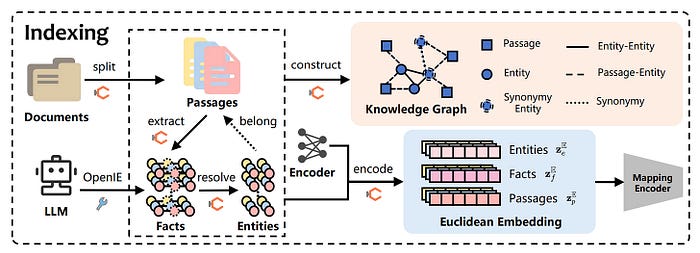
Figure 2: Indexing pipeline. [Source].
圖 2:索引管線 (indexing pipeline)。[來源]。
In the indexing stage, every passage, entity, and fact is encoded into a Euclidean vector zᴱ with a shared pretrained encoder, with facts serving as relational annotations rather than graph nodes.
在索引階段,每個段落、實體與事實都會以一個共享的預訓練編碼器 (pretrained encoder) 編碼成一個歐幾里得向量 zᴱ,其中事實作為關係性的標註,而非圖的節點。
Then comes a small twist. A type-specific predictor estimates the depth score between 0 and 1.
接著出現一個小巧的轉折。一個類型專屬的(type-specific)預測器估算出介於 0 到 1 之間的深度分數 (depth score)。
Crucially, before positioning in hyperbolic space, the model fuses the original semantic vector with the hierarchical features via concatenation and a gating mechanism. This ensures the embedding retains its semantic meaning while adapting to the hierarchy. The depth score then regulates the norm of this refined vector.
至關重要的是,在於雙曲空間中定位之前,模型透過串接 (concatenation) 與一個門控機制 (gating mechanism) 將原始的語意向量與階層特徵融合。這確保了嵌入在適應階層的同時仍保留其語意意義。接著,深度分數會調節這個精煉後向量的範數 (norm)。
This depth score rescales the vector norm: more abstract passages or entities are placed closer to the center, while more specific passages, entities, and facts are pushed toward the boundary.
這個深度分數會重新縮放向量的範數:較抽象的段落或實體被置於較靠近中心處,而較具體的段落、實體與事實則被推向邊界。
Finally, each adjusted vector is mapped into a Poincaré ball, producing its hyperbolic counterpart zᴴ. The result: embeddings that reflect both meaning and position in a conceptual hierarchy.
最後,每個調整後的向量被映射到一個龐加萊球 (Poincaré ball) 中,產生其雙曲對應向量 zᴴ。結果是:嵌入同時反映了意義以及在概念階層中的位置。
Press enter or click to view image in full size
按下 enter 鍵或點擊以檢視完整大小的圖片

Figure 3: Overview of the hierarchical enhancement process. [Source].
圖 3:階層增強流程概覽。[來源]。
2. Unsupervised Bidirectional Alignment / 2. 無監督雙向對齊
To make the hyperbolic space more than a visualization trick, the model introduces an unsupervised geometric constraint: each passage and the facts extracted from it should lie closer together in hyperbolic space.
為了讓雙曲空間不只是一種視覺化的把戲,模型引入了一個無監督 (unsupervised) 的幾何約束:每個段落與從中抽取出的事實在雙曲空間中應彼此更為接近。
- From passage to facts: A passage should lie closer to the facts it contains than to unrelated facts.
-
從段落到事實:一個段落與它所包含的事實之間的距離,應該比與不相關事實之間的距離更近。
-
From facts to passage: A fact should be closer to the passage it came from than to others.
- 從事實到段落:一個事實與它所來自的段落之間的距離,應該比與其他段落之間的距離更近。
These constraints are implemented via margin-based contrastive losses, encouraging the hyperbolic layout to reflect the containment structure in the text.
這些約束透過基於邊際 (margin-based) 的對比損失 (contrastive loss) 來實作,鼓勵雙曲佈局反映出文本中的包含結構。
3. Dual-Space Retrieval with Mutual Ranking / 3. 具相互排名的雙空間檢索
At retrieval time, the model runs two parallel Personalized PageRank processes:
在檢索時,模型會執行兩個平行的個人化 PageRank (Personalized PageRank) 流程:
- In the Euclidean branch, the model computes cosine similarity between the query and both fact and passage embeddings, merges these into a seed distribution over the passage–entity graph, and runs PPR to obtain the Euclidean ranking Rᴱ.
-
在歐幾里得分支中,模型計算查詢與事實嵌入及段落嵌入兩者之間的餘弦相似度 (cosine similarity),將這些合併為段落—實體圖上的種子分佈 (seed distribution),並執行 PPR 以取得歐幾里得排名 Rᴱ。
-
The hyperbolic branch measures similarity using negative hyperbolic geodesic distance between the query and hyperbolic embeddings. It then runs propagation on the same shared graph structure, resulting in a separate ranking list, Rᴴ.
- 雙曲分支則使用查詢與雙曲嵌入之間的負雙曲測地線距離 (hyperbolic geodesic distance) 來衡量相似度。接著它在相同的共享圖結構上執行傳播,產生一個獨立的排名清單 Rᴴ。
Press enter or click to view image in full size
按下 enter 鍵或點擊以檢視完整大小的圖片

Figure 4: Illustration of the dual-space retrieval framework. [Source].
圖 4:雙空間檢索框架示意圖。[來源]。
These two rankings are later combined to produce the final result.
這兩個排名稍後會被合併以產生最終結果。
Each space brings a different strength: Euclidean for surface-level similarity, hyperbolic for structural depth.
每個空間都帶來不同的優勢:歐幾里得空間擅長表面層級的相似性,雙曲空間擅長結構深度。
To combine them, the model converts the rankings from both spaces into reciprocal rank scores ( s_E and s_H ). Passages appearing in both top lists receive a consistency bonus b . The final hybrid score is calculated as:
為了將兩者結合,模型將來自兩個空間的排名轉換為倒數排名分數 (reciprocal rank score)(s_E 與 s_H)。同時出現在兩份頂端清單中的段落會獲得一致性獎勵 b。最終的混合分數計算如下:
This fusion balances relevance with structure, helping the system retrieve not just what's related, but what actually matters in context.
這種融合在相關性與結構之間取得平衡,幫助系統檢索的不僅是相關的內容,而是在脈絡中真正重要的內容。
Evaluation / 評估
To assess downstream, end-to-end QA performance, HyperbolicRAG is evaluated in an end-to-end QA setup.
為了評估下游的端到端問答 (QA) 效能,HyperbolicRAG 在一個端到端的問答設定中接受評估。
To ensure a fair comparison, all methods use the same generator, Llama-3.3–70B-Instruct, which is given the top-5 passages retrieved by each method as context.
為確保公平比較,所有方法都使用相同的生成器 Llama-3.3–70B-Instruct,並以各方法檢索出的前 5 段段落作為脈絡輸入。
Press enter or click to view image in full size
按下 enter 鍵或點擊以檢視完整大小的圖片

Figure 5: EM AND F1 (%) PERFORMANCE COMPARISON OF RETRIEVAL METHODS USING THE TOP-5 RETRIEVED PASSAGES. [Source].
圖 5:使用前 5 段檢索段落之檢索方法的 EM 與 F1(%)效能比較。[來源]。
Figure 5 shows how the numbers stack up:
圖 5 顯示了這些數字如何對比:
- HyperbolicRAG: 51.4% EM / 63.3% F1
-
HyperbolicRAG: 51.4% EM / 63.3% F1
-
HippoRAG2: 51.0% EM / 62.7% F1
-
HippoRAG2: 51.0% EM / 62.7% F1
-
NV-Embed-v2–7B: 49.0% EM / 60.0% F1
- NV-Embed-v2–7B: 49.0% EM / 60.0% F1
While the average improvement over the strongest baseline, HippoRAG2, is modest, HyperbolicRAG highlights that it particularly excels on multi-hop datasets, for example, achieving a +2.3 EM gain on MuSiQue (39.5% vs. 37.2%) and also improving on 2Wiki, suggesting that stronger hierarchical evidence can especially benefit complex, multi-hop reasoning.
雖然相較於最強的基線 HippoRAG2,其平均改善幅度並不大,但 HyperbolicRAG 強調它在多跳資料集上特別出色,例如在 MuSiQue 上取得 +2.3 的 EM 提升(39.5% 對比 37.2%),並在 2Wiki 上也有改善,顯示更強的階層證據對於複雜的多跳推理特別有益。
This gain is most pronounced on multi-hop reasoning tasks, validating the benefit of hierarchical awareness.
這種增益在多跳推理任務上最為顯著,驗證了階層感知所帶來的好處。
Thoughts / 思考
The idea behind HyperbolicRAG, adding a geometric layer on top of GraphRAG, is fresh and technically interesting.
HyperbolicRAG 背後的構想——在 GraphRAG 之上加入一個幾何層——既新穎又在技術上引人入勝。
But in my view, whether it's worth the added architectural complexity of maintaining dual-space representations is a tougher call from an engineering perspective.
但在我看來,從工程的角度來看,是否值得為此增加維護雙空間表示的架構複雜度,是個比較難下的判斷。
Where this approach truly shines is in domains with structured, deeply hierarchical knowledge bases and multi-hop questions, such as medical data, legal corpora, or scientific literature. In these settings, hyperbolic space naturally handles hierarchy and helps reduce the hubness problem that plagues Euclidean embeddings.
這種方法真正發光發熱之處,在於具有結構化、深度階層式知識庫以及多跳問題的領域,例如醫療資料、法律語料庫 (legal corpora) 或科學文獻。在這些情境中,雙曲空間天生就能處理階層,並有助於緩解困擾歐幾里得嵌入的樞紐性問題。
Outside of that, for general-purpose search or single-hop RAG tasks, this level of geometric complexity is probably overkill.
除此之外,對於通用搜尋或單跳 (single-hop) RAG 任務而言,這種程度的幾何複雜度大概是過度設計了。
Reference: HyperbolicRAG: Enhancing Retrieval-Augmented Generation with Hyperbolic Representations.
參考文獻:HyperbolicRAG:以雙曲表示增強檢索增強生成。
🔤 關鍵術語
| 英文 | 繁中譯名 | 文章中的脈絡 / 簡短說明 |
|---|---|---|
| HyperbolicRAG | 雙曲空間檢索增強生成 | 本文主角,在標準歐氏空間外引入雙曲表示空間,讓嵌入能自然表達階層結構 |
| GraphRAG | 圖譜檢索增強生成 | 將文件轉成圖譜、連結實體與段落,再用多跳傳播改善推理的 RAG 方法 |
| RAG (Retrieval-Augmented Generation) | 檢索增強生成 | 先用密集檢索取出相關段落,再交給語言模型回答問題的框架 |
| dense retrieval | 密集檢索 | 傳統 RAG 用來取回相關段落的向量檢索方式 |
| multi-hop reasoning | 多跳推理 | 需跨多個節點/證據鏈推導答案的推理任務,HyperbolicRAG 在此特別出色 |
| hyperbolic space / hyperbolic geometry | 雙曲空間/雙曲幾何 | 一種能自然支援階層結構的幾何,抽象概念近中心、具體事實近邊界 |
| Euclidean space | 歐氏空間 | 目前多數圖譜式 RAG 嵌入節點所用的平坦空間,缺乏階層深度的幾何概念 |
| Poincaré ball | 龐加萊球模型 | 調整後的向量最終被映射到此模型,產生雙曲對應嵌入 zᴴ |
| hubness | 樞紐性(hub 問題) | 高維歐氏空間中泛化概念靠近所有點,導致檢索漂向籠統節點的已知問題 |
| embedding space / vector embeddings | 嵌入空間/向量嵌入 | 知識存活的表示空間;本文指出其過於平坦無法表達階層 |
| knowledge graph | 知識圖譜 | 由段落、實體、事實構成的異質 passage–entity 圖 |
| Personalized PageRank (PPR) | 個人化 PageRank | 在共享圖結構上做傳播以取得排序的演算法,雙空間各跑一次 |
| entity / passage / fact | 實體/段落/事實 | 知識圖譜三類元素,事實作為關係註解而非圖節點 |
| geodesic distance | 測地線距離 | 雙曲分支用負雙曲測地線距離衡量查詢與嵌入的相似度 |
| cosine similarity | 餘弦相似度 | 歐氏分支用來計算查詢與事實/段落嵌入相似度的指標 |
| contrastive loss (margin-based) | (基於邊界的)對比損失 | 實作無監督幾何約束,使段落與其事實在雙曲空間更靠近 |
| reciprocal rank | 倒數排名 | 將兩空間排序轉成分數以融合的方法,加上一致性加成 b |
| dual-space retrieval | 雙空間檢索 | 同時跑歐氏與雙曲兩條 PPR 分支再融合排序的框架 |
| EM / F1 | 完全匹配/F1 分數 | 端到端 QA 的評估指標(如 HyperbolicRAG 51.4% EM / 63.3% F1) |
| HippoRAG2 / G-Retriever / LightRAG | (各圖譜式 RAG 基線方法) | 文中比較的圖譜式 RAG 方法,多數在歐氏空間嵌入節點 |