Orchestrating Multiple AI Roles in Manus with Shared Context and Tool Awareness
Author: Bhagya Rana
Published:
Source: https://medium.com/@bhagyarana80/orchestrating-multiple-ai-roles-in-manus-with-shared-context-and-tool-awareness-9b34859ff791
Fetched: 2026-06-07T02:05:00.991488
Orchestrating Multiple AI Roles in Manus with Shared Context and Tool Awareness
How to design distinct AI personas that collaborate seamlessly with unified memory and smart execution
Press enter or click to view image in full size
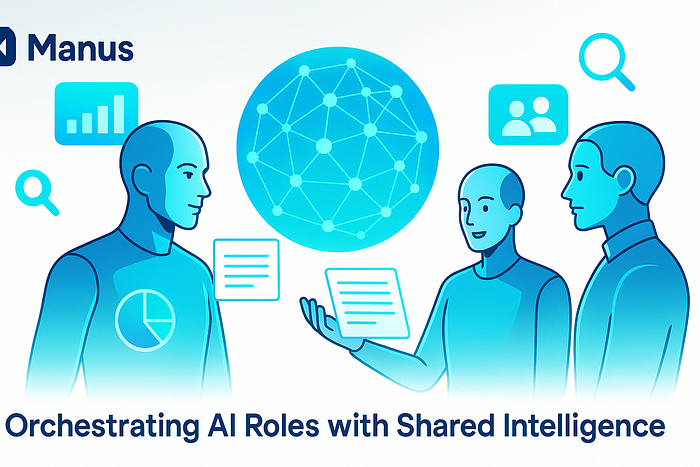
Explore how to build collaborative AI agents in Manus using shared memory, contextual awareness, and dynamic tool integration for advanced workflows.
Introduction: Beyond the One-AI Model
Imagine if your AI assistant could break into a team of specialists — each with a defined role, personality, and toolset — but still think like one mind. That’s not a scene from science fiction. It’s the next frontier in practical agent orchestration using Manus, the rising platform for multi-agent intelligence.
Whether you’re building a research copilot, automating cross-department workflows, or experimenting with autonomous agents, the days of one-bot-does-it-all are fading. Instead, modular, persona-driven AIs — coordinated through shared context and intelligent tool awareness — are emerging as the more powerful, scalable design pattern.
In this article, we’ll dive deep into how to architect multiple AI agents in Manus that operate with clear domain responsibilities but retain a shared brain and execution logic. You’ll learn practical strategies, pitfalls to avoid, and how this approach can unlock richer interactions, smarter automation, and more humanlike collaboration.
Why Split a Single Agent into Multiple Roles?
Before diving into tooling, let’s explore why you’d want multiple AI roles instead of a monolithic assistant.
- Specialization: Just like human teams, agents perform better when they specialize. A data analyst persona can handle Pandas and charts, while a content strategist handles tone and messaging.
- Modularity: Updating one agent’s logic or personality doesn’t risk the whole system breaking.
- Realism: When users interact with multiple agents, each with a name, style, and role, the experience feels more natural and trustworthy.
- Parallelism: Agents can work concurrently — summarizing, planning, and fact-checking simultaneously.
Now, the challenge: keeping them in sync without context fragmentation or duplicated memory.
The Secret Sauce: Shared Memory and Context Linking
Manus excels in this regard. With its memory architecture, you can allow multiple agents to read and write from a central context graph. Think of it as a dynamic, evolving knowledge base accessible to all agents.
Key Strategies:
- Unified memory namespace: Design all agents to log observations, actions, and key decisions into a single context stream.
- Role tagging: When each agent writes to memory, tag the source (e.g.,
[WriterBot] Suggested intro paragraph...) to preserve traceability. - System messages with semantic anchors: Seed agents with templated prompts that reference shared variables (
{{project_context}},{{client_feedback}}, etc.)
This way, even though the agents operate independently, they function as a collective intelligence.
Persona Design: Crafting Distinct Yet Collaborative Agents
Designing agents with character is more than just giving them a name.
Key elements:
- Voice & Tone: Is this agent friendly or formal? Direct or reflective?
- Tool Affinity: Only give tools that match their function (e.g.,
CodeInterpreterfor DevBot,SearchAPIfor FactChecker). - Execution Boundaries: Let each persona take the lead only within its responsibility zone.
Example setup in Manus:
{
  "agents": [
    {
      "name": "Strategist",
      "role": "Content strategy and audience modeling",
      "tools": ["SearchAPI", "PersonaProfiler"],
      "style": "Insightful, data-driven"
    },
    {
      "name": "WriterBot",
      "role": "Writing and tone polishing",
      "tools": ["LanguageModel"],
      "style": "Conversational, polished"
    },
    {
      "name": "AnalystBot",
      "role": "Data review and chart generation",
      "tools": ["CodeInterpreter", "DataVisualizer"],
      "style": "Concise, analytical"
    }
  ]
}
Each agent can invoke tools or consult memory, but they’re designed to avoid overstepping. Manus lets you enforce these constraints at runtime or via prompt schema.
Tool Awareness: Teaching Agents to Know What They Can Use
Another Manus superpower is tool chaining. But here’s the catch — if agents don’t know what tools they have, or when to use them, things fall apart.
Embed a self-awareness prompt early in their system message:
“You are equipped with
SearchAPIandPersonaProfiler. Use these tools only when answering questions about audience or competitive research.”
Even better, dynamically inject available tools based on system context. This prevents misuse and improves reliability.
Real-World Use Case: Marketing Content Co-Pilot
Let’s say you’re building an AI that helps a content agency plan and write articles.
- StrategistBot researches the niche and audience using the search tool.
- WriterBot drafts headlines and outlines.
- AnalystBot reviews engagement metrics and suggests performance improvements.
All three share memory of previous campaigns, brand voice guidelines, and editorial feedback.
Result? Cohesive, on-brand content with specialized depth — without needing to prompt each AI separately.
Common Pitfalls to Avoid
- Overlapping agent duties → creates confusion and duplicative responses.
- Disjointed memory logs → fragments context and leads to hallucinations.
- Hardcoded tool lists → reduces flexibility and scalability.
Instead, invest in:
- A well-structured memory graph
- Persona boundaries and scoped permissions
- Dynamic tool registration based on roles
Conclusion: Toward a More Humanlike AI Ecosystem
By orchestrating AI agents in Manus with distinct personas, shared context, and tool awareness, you’re not just building assistants — you’re designing intelligent teams. This structure opens the door to deeper automation, more believable conversations, and scalable intelligence that mirrors human collaboration.
As the multi-agent paradigm matures, those who adopt these patterns early will be ahead of the curve in product design, automation, and user experience.
If you’re building with Manus or curious about this kind of architecture, drop a comment below. I’d love to hear how you’re structuring your AI teams — or help brainstorm your next one.
👉 Found this helpful?
Clap it up, share it with your dev team, and follow for more deep dives into practical multi-agent systems and AI orchestration strategies.